

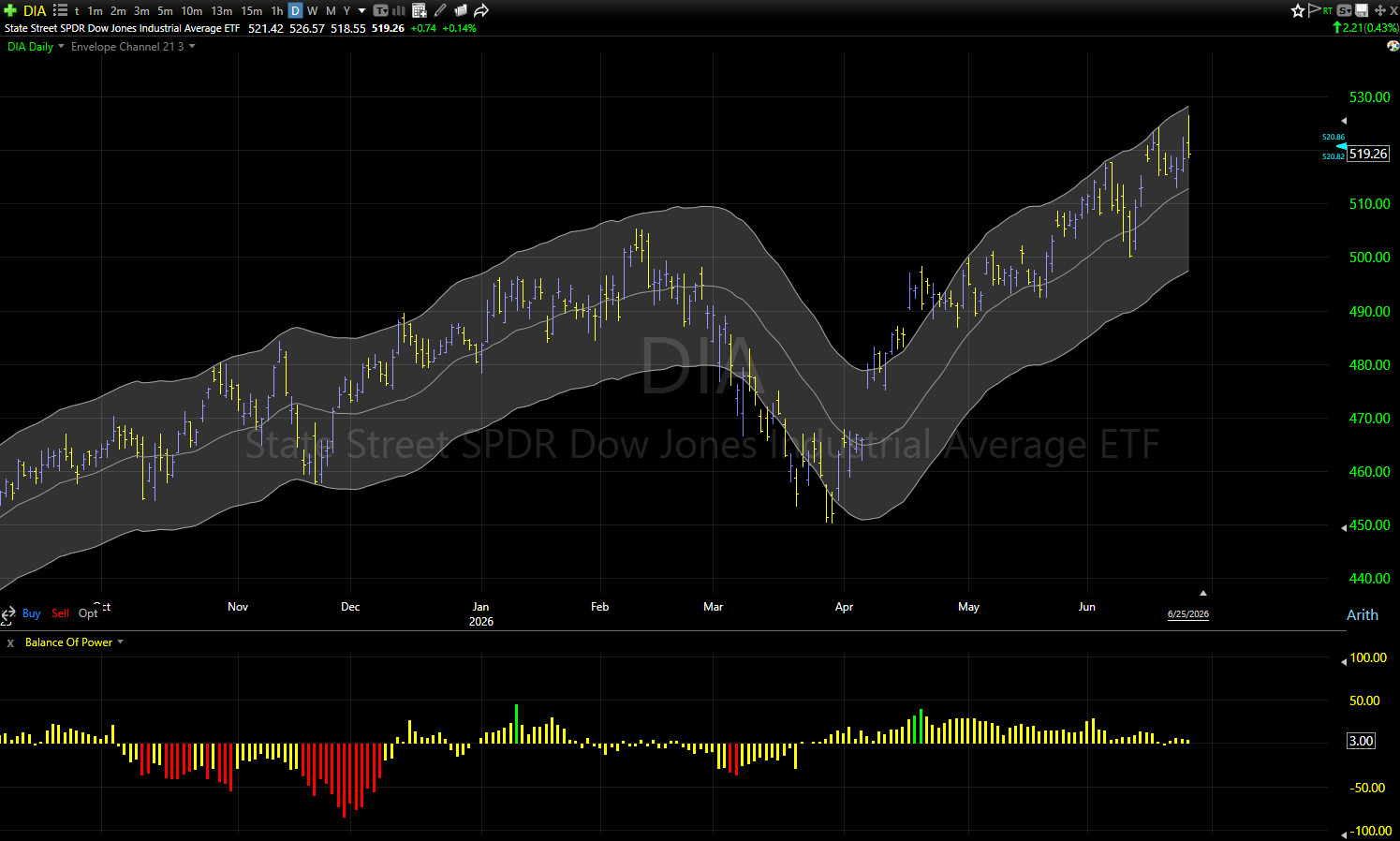
By David Rogers. BLOWING ROCK, N.C. — Buoyed by hope that the Iran war will soon be resolved, the Dow Industrials and other broad market averages have struggled higher in recent weeks. Nonetheless, there are signs that the AI-induced bubble that has been responsible for perceived gains in productivity may be cracking, with potentially adverse market action in the intermediate term. That said, we continue to feel the Dow Jones Industrial Average (DJIA) will be at 100,000 within 10-15 years.
That’s the long-term view but, in the interim, a market “correction” is increasingly probable. Market corrections take some combination of two basic forms: harsh price decline or sideways consolidation over time. It is during those corrective times that hedging long equity portfolios can be beneficial in protecting assets.
Our longer-term target of 100,000 has very little (and maybe nothing) to do with who is occupying the Oval Office. After successful companies pay taxes and distribute dividends, they typically reinvest earnings in the company. The implication is that over time there is a growing intrinsic value of the company, which only gets magnified by inflation. And the economic system “managed” by our federal government features fiat dollars: dollars that the Federal Reserve has printed out of thin air. Whether you like it or not, inflation is built into the system.
How Does Inflation Impact Stock Prices?

Let’s be simplistic. Assume that a company generates $1.00 per common share in earnings and “the market” applies a standard multiple of 10 times earnings, giving us a $10 stock. In 10 years, because of inflation the company with the same level of business activity may produce $3.00 per share in earnings. Its earnings reports may be much ballyhooed because of the “record” results, but in reality the company isn’t doing any better or any worse than 10 years earlier. Because of inflation over that 10 years, the dollars are cheaper but the market is still apt to assign a standard multiple of 10x earnings, giving the shares a $30 per share valuation.
That may be overly simplistic, but is the 87 octane gasoline that costs $4.00 per gallon today that much better quality than the $2.14 we paid in 2016? Today, we pay about $4.22 for a gallon of whole milk. In 2016, it was about $3.25. Is it any more nutritious today? According to USA Today, the average new car in 2016 cost roughly $34,000. Today the average new car goes off the lot at about $47,000. Now there are a lot of other potential variables that might be constricting supply in a demand-driven market, but inflation is a major reason for the higher prices — and it is built into the system. Ever read about the Federal Reserve’s “target” inflation rate for Personal Consumption Expenditures Price Index? https://www.federalreserve.gov/economy-at-a-glance-inflation-pce.htm
The inflation-induced reasons for higher stock market index prices over time are also affected by what I call the averages’ built-in bias. Periodically, Dow Jones, Standard & Poor’s, Nadaq and other publishers of market indices throw out underperforming companies and replace them with higher performing names. Given the R-factor (reinvestment of corporate earnings after paying taxes and distributing defends), the impact of inflation and the bias embedded in the market averages, higher valuations over time are almost a given.
But that doesn’t mean that intermediate-term and short-term “hiccups” will not occur. They will, if the timing of their occurrence is not quite as certain as death and taxes.
DISCLAIMER: The information provided in this publication is for informational and educational purposes only and does not constitute investment advice, financial advice, or a recommendation to buy or sell any securities. The opinions expressed are those of the authors and are subject to change without notice.
Investing in the stock market involves risk, including the possible loss of principal. Past performance is not indicative of future results. Readers should conduct their own research and consult with a qualified financial advisor before making any investment decisions.
This publication and its contributors may hold positions in the securities mentioned and may buy or sell such securities without notice.