

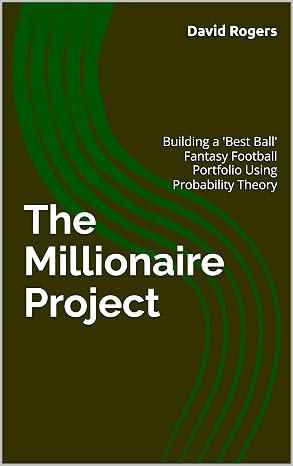
By D.X.D. Hall. BLOWING ROCK, N.C. — A second book, but a different theme. Blowing Rock author and Managing Editor of Blowing Rock News, David Rogers has published another book, this one about fantasy football.
The Millionaire Project records 100 entries in DraftKings’ NFL Best Ball $20M Millionaire contest, each entry costing $25. What makes this $2,500 investment special? Rogers employs elements of “probability theory” in making his draft selections—in pursuit of a $3 million top prize.
“What makes this book really different,” said Rogers, “is that I am publishing all of the draft selections before the season begins on September 9th. I’m not cherry-picking any single drafts as representative of how good I might be. All of my drafts are a matter of public record, laid bare for anyone to evaluate before, during or after the 2026 season.”
Rogers shared that a second, post-season book is planned that evaluates the 100 entries, plus the add-ons he drafted based on what he learned in drafting the first hundred. It was a total of another $1,250 in entry fees.

“The odds of winning the $3 million first place prize with just a single entry are pretty slim. There are some 940,880 entries in this one tournament, so your odds are close to a million-to-one,” explained Rogers. “Obviously, you narrow the odds with each additional entry and a different combination of players in each 20-round lineup. That’s one element of probability theory, creating a portfolio of entries much like you might do with stock market investments. Instead of one chance, you have multiple chances, improving the odds that one of them will score more than the rest.”
For a lot people, winning the $3 million 1st prize is a life-changing experience.
Like in other fantasy sports drafts, Best Ball entries are about prioritizing the NFL players you expect to produce the most fantasy points each week and throughout the season. If a player gets hurt for a game or two or even the whole season, your roster can suffer. On the other hand, if some of the players you draft in the later rounds “spike” in any given weeks so they get into the scoring lineup, they could be difference makers.
“Every individual following NFL football has opinions about who are the best players at their respective positions, and maybe overall,” said Rogers. “In Best Ball, for each entry you are drafting against 11 other people in a live ‘snake draft’ prior to the start of the season. You have to decide in what order you want to select your players and after the very first selection is made you run the risk that someone else will beat you to your next preferred selection. In reality, nobody gets all their favorites at each position so you have to be prepared to adapt. And what makes it really interesting is that every single draft has a different personality. Sometimes running backs go off the board first, other times a draft might be more heavily weighted toward wide receivers or quarterbacks being taken early on. You don’t know the other drafters and they don’t know you.”
Even with 100 entries, the odds are not favorable but I think using elements of probability theory can enhance your chances. That’s my thesis.
After a draft is completed in Best Ball, Rogers noted, there are no roster changes. For each NFL week of the regular season, an entrant’s highest scoring players become his or her starting lineup and count toward the entrant’s season-long fantasy point total. Round 1 of the tournament includes scoring in Weeks 1-14. From Round 1, the top two point earners in each draft move on to Round 2 (Week 15), so suddenly the 940,000-plus contest has been reduced to about 150,000. After that, only one player advances from the new, randomly matched 12-person competitions until only 1,089 remain in Round 4 (Week 18). Of that number, 1st place gets $3 million; 2nd Place gets $2 million; 3rd Place gets $1 million; 4th. $500645; 5th, $400,000; 6th, $300,000; 7th, $250,000; 8th, $200,000; 9th-10th, $150,000; 11th-15th, $100,000; 16th-20th, $50,000; 21st-25th, $40,000; 26th-35th, $30,000; 36th-50th, $20,000; 51st-75th, $15,000; 76th-100th, $10,000; 101st-150th, $7,500; 151st-200th, $5,000; 201st-300th. $4,000; 301st-400th, $3,000; 401st-500th, $2,000; 501st-700th, $1,500; 701st-1,089th, $1,250.”
But, it turns out, adding entries is not the end-all in Rogers’ applying probability theory.
“Every NFL offensive player at each position either has a known history of passing, rushing, or receiving. If a rookie, they have well-published prospects,” said Rogers. “So the top performers are likely to be drafted in the early rounds. What can really separate your roster’s fantasy point-scoring potential is how well you have evaluated the lesser known or still developing players. So, in my 100 drafts, I have added another kind of probability theory. For example, let’s say that I draft Trey McBride of the Arizona Cardinals and Brock Bowers of the Las Vegas Raiders early. They are both tight ends, figuring to be the top producers at their position. I may only need to draft those two, which saves roster spots for the QB, RB and WR positions. If I waited on selecting quarterbacks, even though only one contributes to my 8-player scoring lineup each week, I might draft three or four QBs, increasing the probability that one of them will score high in any given week.
Success can be measured in terms of money won, of course. But then, not everyone has to go to Disney World (which can be just as expensive) to get entertainment or have a learning experience.
“It is the same with the other positions,” Rogers added. “Only two running backs contribute points each week, so if I can get Jahmyr Gibbs of the Detroit Lions and Derrick Henry of the Baltimore Ravens early on, plus another couple of steady producers in the early-to-mid rounds, I might only select four to six RBs to cover that position, allowing me to draft more players for the positions I ignored in the early rounds. For the under-represented positions, I like to draft players who have a history of one or more spike weeks during the season. Those spike weeks mean more to my scoring roster than a player who scores only a modest number of fantasy points every week.”
What would winning mean?
“For a lot of people, winning a $3 million first prize would be a life-changing event. Sure, I’d like to win that, not so much for me but for family members I leave behind or giving to special causes that I believe in,” said Rogers. “But again, even with 100 entries the odds are not really very good considering there are more than 940,000 entries you are competing against. Success might only be winning more money than the $2,500 I have invested in this project. On the other hand, it has been fun and educational, so I guess we have to measure that against other choices we could have made for entertainment and learning. Not everyone has to go to Disney World to have a good time!”
The Millionaire Project: Building a Best Ball Fantasy Football Portfolio Using Probability Theory is available for purchase on Amazon as an e-book for $11.49. It is 443 pages in length, including several appendices.
LINK to AMAZON: CLICK HERE
In 2006, Rogers penned The 90 Percent Solution: Higher Returns, Less Risk (2006, John Wiley & Co., New York, an NYSE-listed publishing house), with a stock market investing theme. He has three other book projects currently in production, including another stock market-related book (Dow 100,000) and an as yet untitled work featuring thoughts on fixing college sports. The more distant project is a crime-thriller novel, with the fictitious story to be based in Blowing Rock and the High Country.
Rogers took up community journalism after retiring from a 35-year career in the financial services industry. He operated Blowing Rock News from 2010 to 2020, but when COVID-19 created uncertainty in the market for advertising, he joined Mountain Times Publications as editor of The Blowing Rocket and as a sports coverage contributor. In September 2022, he left MTP to start High Country Sports and then relaunched Blowing Rock News in 2023. He merged the two digital-only publications this past spring.