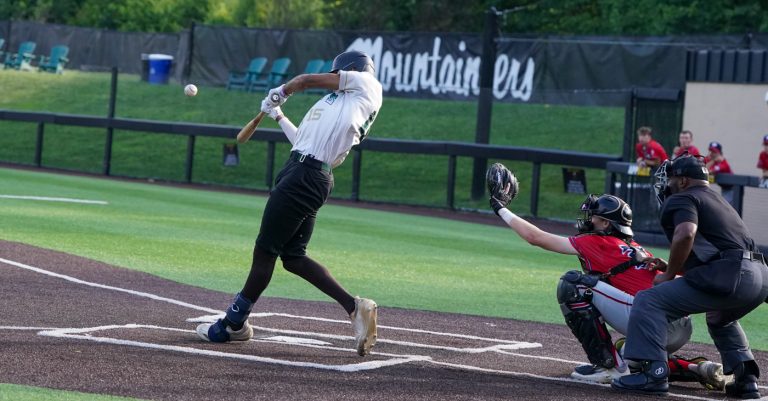
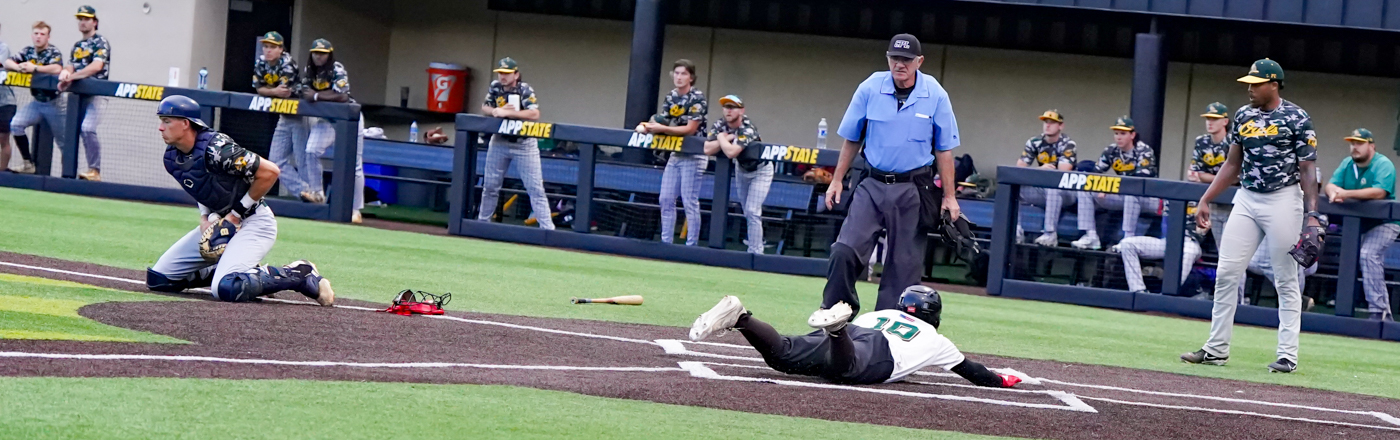
By David Rogers. BOONE, N.C. — Starting off on the right foot — so to speak — the Boone Bigfoots exploded for three runs in the bottom of the first inning against the High Point-Thomasville HiToms, added a couple more runs later and hung on to win, 5-4, on June 26 at Smith Stadium.
One of the hottest-hitting batters in the Coastal Plain League of late, Boone’s Michael Young wasted little time in crushing a towering fly ball over the left-centerfield fence, driving in not only himself but also the leadoff batter, designated hitter Tyler Martin, who walked to open the bottom half of the frame. Young has been shuffled up and down the Bigfoots’ batting order this season but the University of South Alabama’s CPL standout brings his power to wherever he’s inserted.
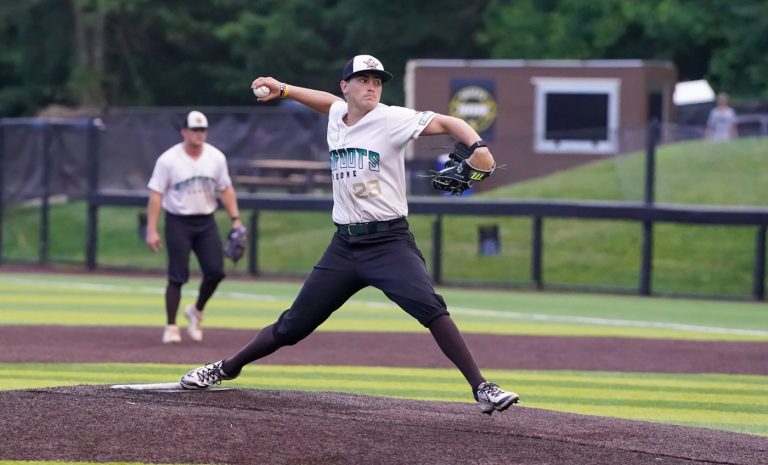
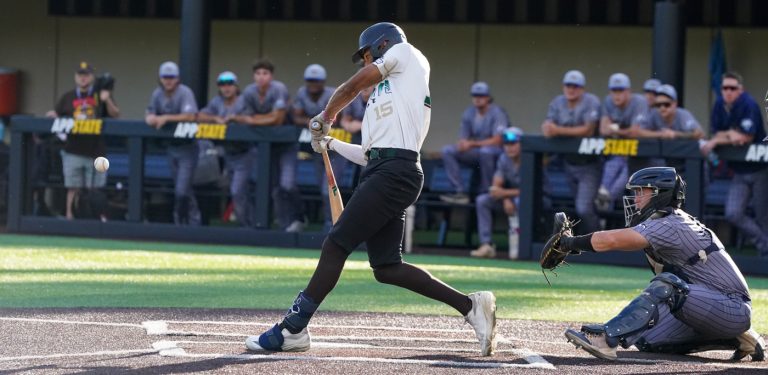
Ray Euson pitched four strong innings for the Bigfoots to earn the win vs. the HiToms on June 26 at Smith Stadium. Photographic image by David Rogers for High Country Sports
On the mound, Ray Euson faced 17 batters in four strong innings and was credited with the win as the Boone starting pitcher, allowing just four hits and one run, walking two and striking out a pair of HiToms batters.
The HiToms didn’t go away quietly. In the 7th inning, the visitors managed three runs off of two different Bigfoots pitchers who had “Born to be Wild” in their DNA on this night. Reliever Andrew Hart hit the HiToms’ Landon Peavy to lead off the inning, then walked the visitors’ Tyler Steele.
A Yates Sikes RBI single to score Peavy sent Hart to the showers and brought Landon Watts to the mound with runners on first and second. That proved only temporary, however, as a passed ball and wild pitch advanced the runners and brought Steele home. Then a Blake Gaffney infield single scored Sikes before Watts settled in and secured the final two outs of the inning — but not before the HiToms had knotted the score at 4-4.
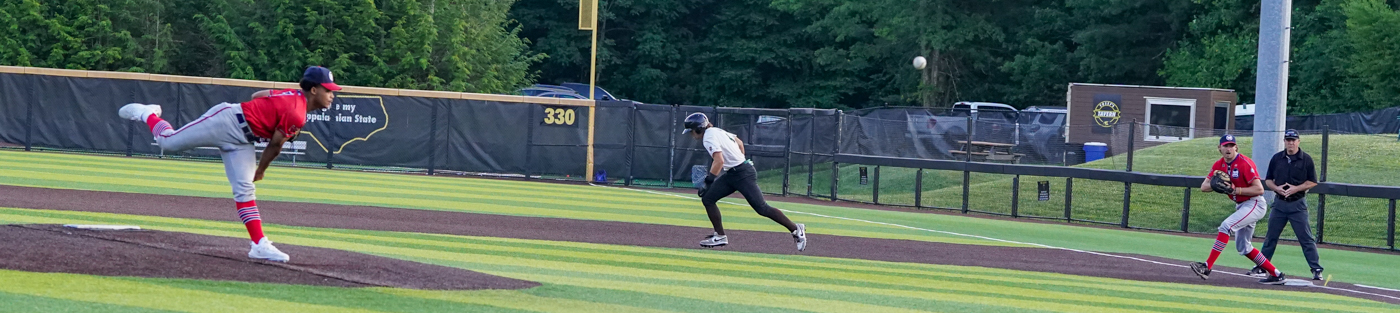
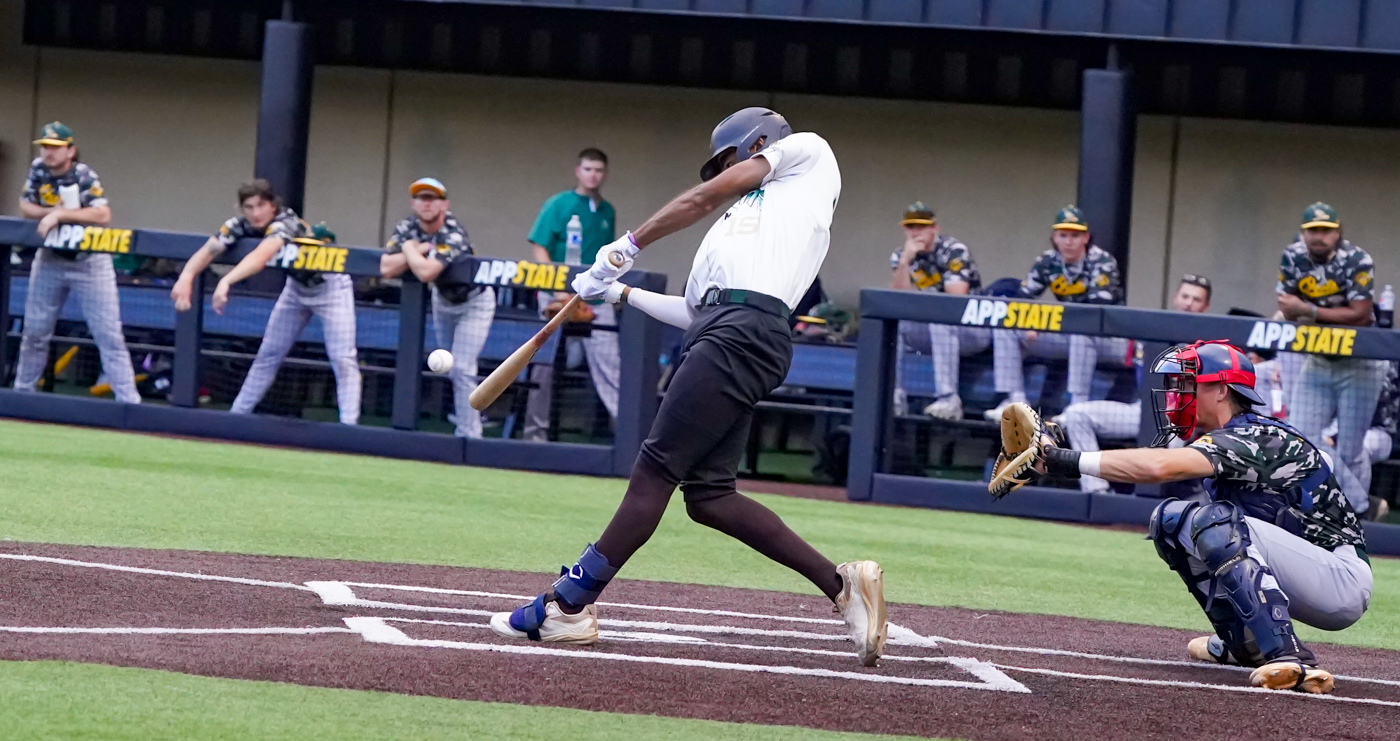
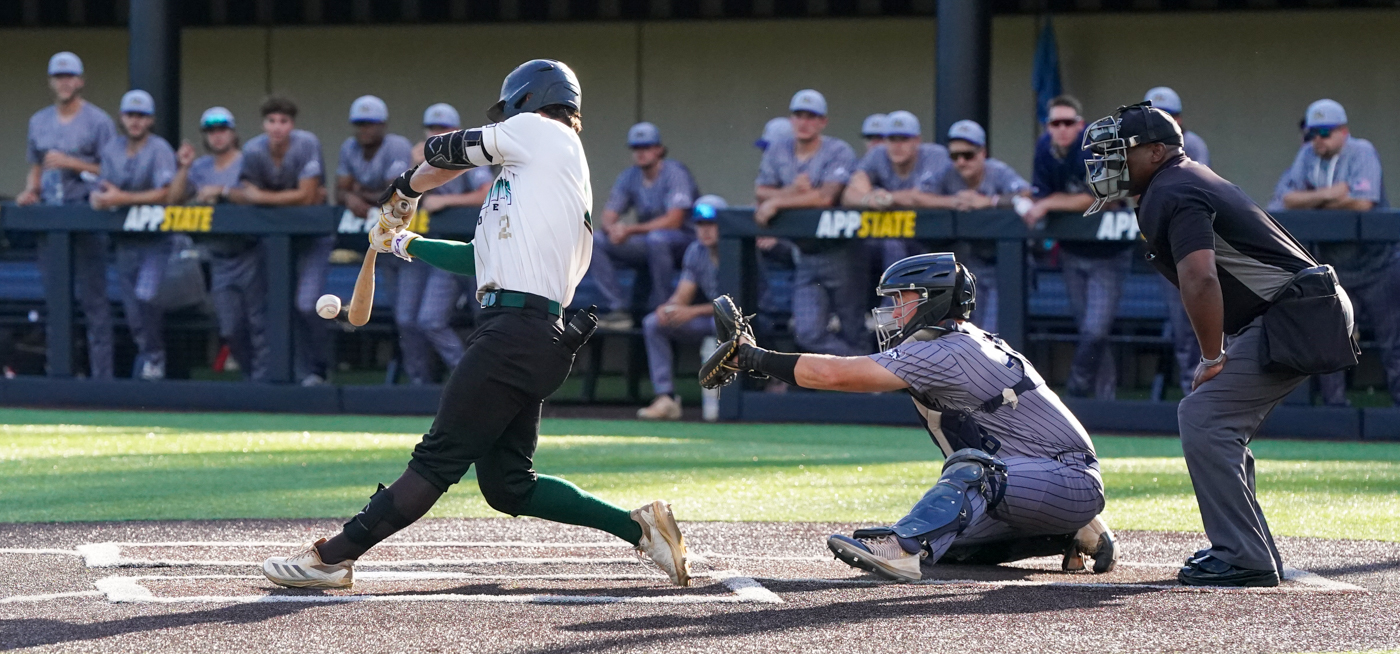
Just a bit inside… Photographic image by David Rogers for High Country Sports
The Bigfoots responded with back-to-back, 2-out doubles in the bottom of the 7th inning to bring across the winning run. First, Davin Whitaker smashed a double to the centerfield fence, then Tyler Renn ripped a 2-bagger to left, driving in Whitaker.
Defense and pitching were the difference makers for the Bigfoots in the later innings. Watts dug in on the mound in the 8th, striking out the first HiToms batter and getting the second to ground out to second base. A single and a stolen base were all that separated that strong opening with the finishing strikeout to end the scoring threat.
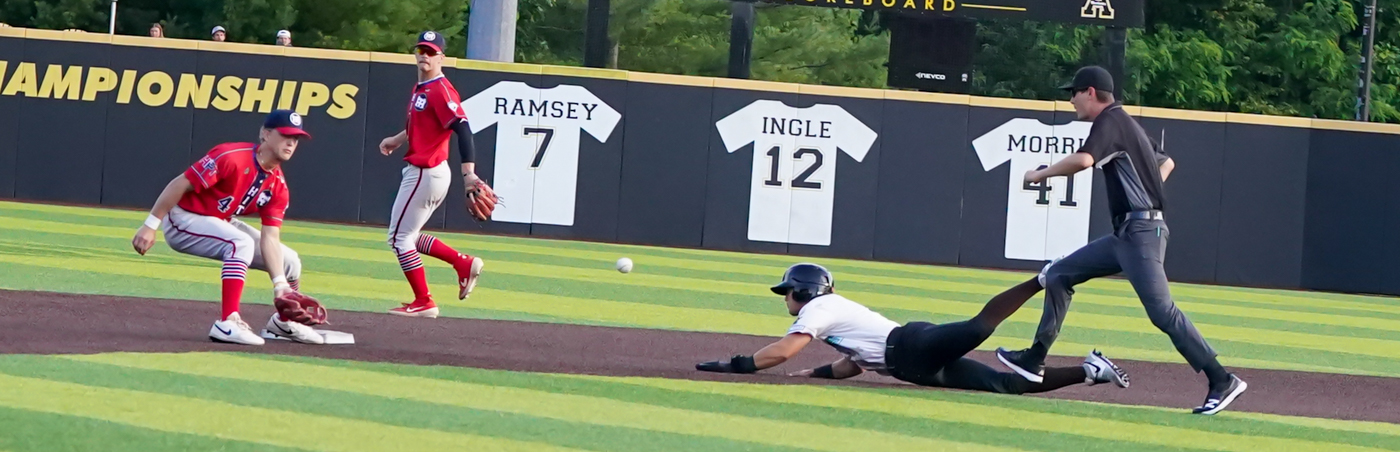
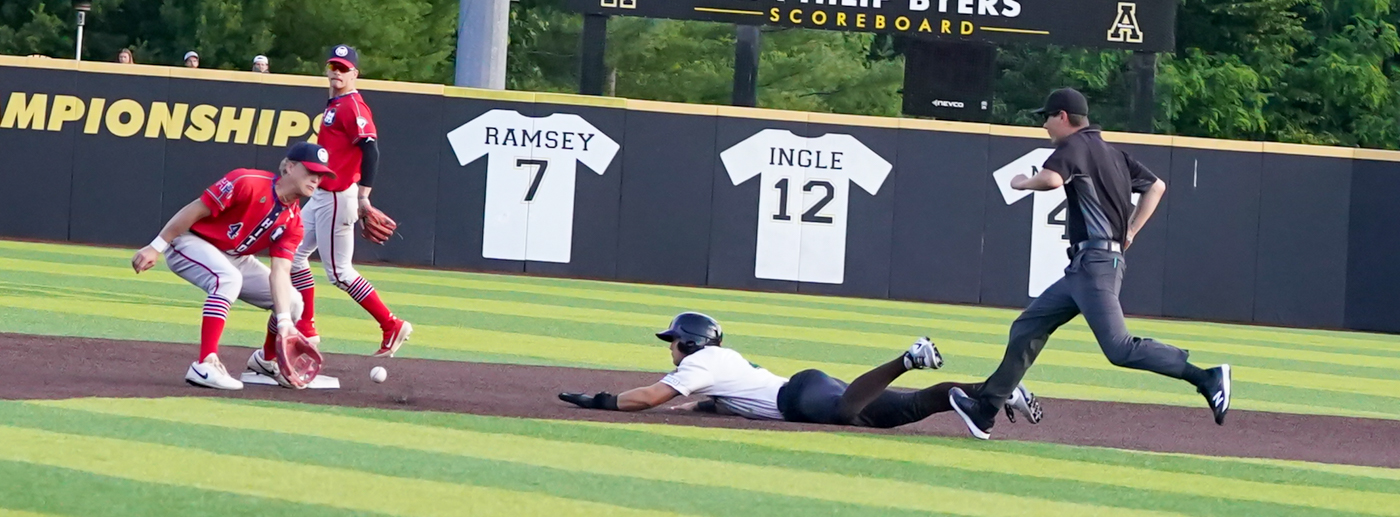
The Sequence
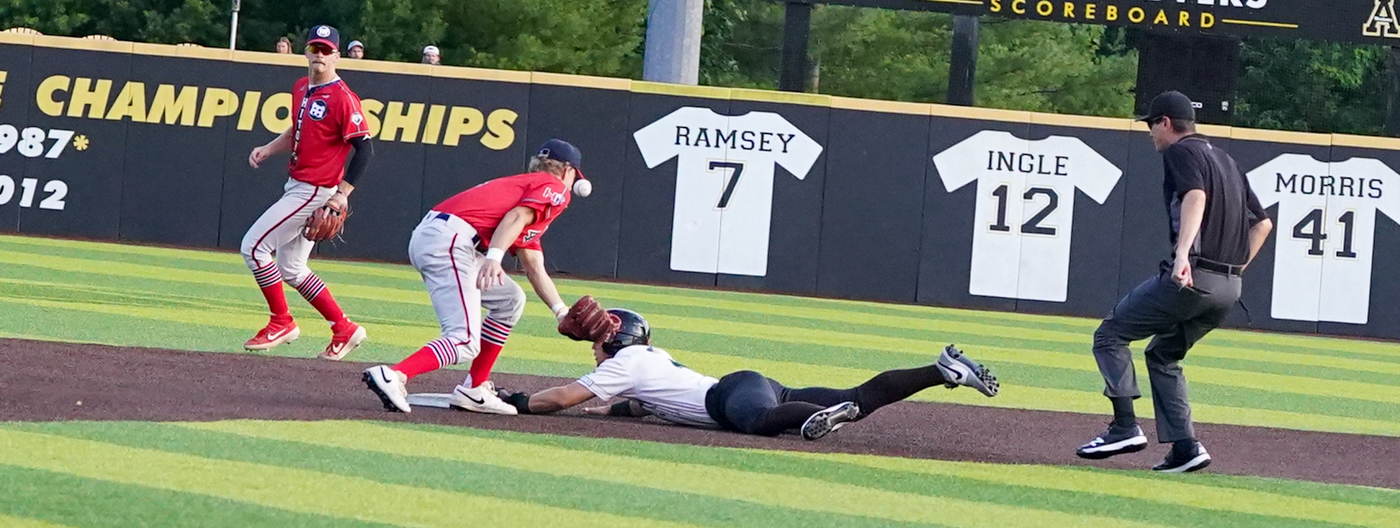
It might look like the Bigfoots Payton Basler will be thrown out by a proverbial mile, but somewhere between the HiToms’ shortstop’s catch and tag, the ball ends up near the infielder’s cheek bone as Basler slides into second base safely on June 26, 2025. Photographic images by David Rogers for High Country Sports
Flame-throwing Bigfoots reliever Jacob Haley was credited with the save, coming on in the 9th inning to face just four batters in retiring the side and securing the home team’s win.
With the win, the Bigfoots improve to 10-10, which puts them in a tie with Martinsville for fourth place in the Coastal Plain League’s West Division.
KEY PERFORMERS
Boone Bigfoots
Ray Ebson (SP): 4 innings pitched, 1 run on 4 hits, walked 2, striking out 2
Michael Young (1B): 1-3, 1 run scored, 2 RBIs, HR
Davin Whitaker (CF): 2-4, 1 run scored, 2B
Tyler Renn (C): 1-3, 1 RBI, 2B
Brady Sullivan (RF): 1-3, 1 run scored, 2 stolen bases
Payton Basler (3B): 0-1, hit by pitch, 2 walks, 2 stolen bases
High Point-Thomasville HiToms
Yates Sikes (CF): 2-3, 1 run scored, 1 RBI
Blake Gaffney (C): 1-2, 1 run scored, 1 RBI
PLAYERS MENTIONED
Ray Euson – Haines City, Fla., Francis Marion University
Michael Young – Montgomery, Ala., University of South Alabama
Davin Whitaker – Mocksville, N.C., East Carolina University
Tyler Renn – Marys Home, Mo., Columbia College
Brady Sullivan – Cypress, Texas, Blinn Community College
Payton Basler – Lansing, Kan., University of Missouri
Jacob Haley – Huntsville, Ala., University of South Alabama
Andrew Hart – Wexford, Pa., Cleveland Community College
Landon Watts – Picayune, Miss., Pearl River Community College
Yates Sikes – High Point, N.C., Western Carolina University
Blake Gaffney – Kannapolis, N.C., Wake Tech Community College
Landon Peavy – Lancaster, S.C., North Greenville University
By David Rogers. BOONE, N.C.— A dramatic 7-run explosion in the 7th and 8th innings broke open a 4-4 deadlock and powered the Boone Bigfoots to a convincing, 11-6 win over Coastal Plain League leader, the Forest City Owls on June 24 at Smith Stadium.
After Boone twice loaded the bases in the bottom of the first inning but were limited to just a single run as Owls starting pitcher Luke Ferguson was able to wiggle out of the jams — thanks in no small measure to baserunning errors by the Bigfoots — the offensive action carried over into the second inning. The Owls sent John Jones to the mound to start the bottom half of the 2nd. It might have been a different pitcher, but the Bigfoots were still on target, offensively. Rightfielder Brady Sullivan (Cypress, Texas; Blinn Community College) led off with a single to right, then second baseman Blaine Lucas (Tomball, Texas; San Jacinto Community College) raced to first base on a dropped third strike by the Owls catcher.
Michael Young launches a 2-RBI double that hit the left centerfield fence on June 24 vs. the Forest City Owls. Photographic image by David Rogers for High Country Sports
The Bigfoots’ designated hitter on this night was Michael Young (Montgomery, Ala.; University of South Alabama). As Boone’s hottest batter in recent games, Young didn’t disappoint, smashing a double off the left-centerfield wall and driving in both Sullivan and Lucas.
The Bigfoots would add another run in the 4th inning behind a strong pitching performance by starter Drew Harrison (Madison, Miss.; Pearl River Community College). The lanky righthander gave up three runs on three hits, striking out seven of the 22 batters he faced while walking none. Of Harrison’s 77 pitches thrown, 56 were strikes.
The Boone Bigfoots’ Blaine Lucas slides home against the Forest City Owls on June 24. Photographic image by David Rogers for High Country Sports
Cole McMichael (Louisville, Ky.; Bellarmine University) took the mound in relief of Harrison to start the 7th inning — and immediately gave up a solo home run to Owls left fielder Matthew Lively (Chapin, S.C.; The Citadel). McMichael settled down to allow only one more baserunner, but that left the score knotted at 4-4.
The Bigfoots responded with four runs of their own in the bottom half of the 7th inning. Young led off with a single for his third hit of the ball game. Then Owls reliever Corben Childers had some control problems, walking Charlie Niehaus (West Chester, Ohio; University of Cincinnati) and hitting Payton Basler (Lansing, Kansas; University of Missouri) to load the bases.
Davin Whitaker (39) had a big night for the Boone Bigfoots on June 24 vs. the Forest City Owls. The Mocksville, NC native attending East Carolina went 3-4, with 1 run scored and 6 RBIs on the night. Photographic image by David Rogers for High Country Sports
Davin Whitaker (Mocksville, N.C.; East Carolina) wasted no time, slashing the second pitch to center for a 2-RBI single, scoring Young and Niehaus. Whitaker and Basler would complete the scoring for the inning a couple of batters later on wild pitches.
It was three up and three down in the top of the 8th for the Owls, with Colin Jenkins (Mt. Olive, Miss.; Pearl River Community College) taking the mound for the Bigfoots, in relief. A flyout to left and a couple of groundouts to third base were all the visitors from Forest City could manage in response.
In the bottom half of the inning, the Bigfoots added three more insurance runs off of another new Owls pitcher, Adam Katz. Grant Watkins (Troon, Neb.; Abilene Christian), Niehaus and Basler all singled to again load the bases full of Bigfoots and Whitaker took advantage by driving a double to the fence, scoring all three of the runners ahead of him.
The Owls, still firmly in first place with an 11-5 record after the loss, threatened to even things up in the top of the 9th inning, but could only manage to score two runs, coming up short on the night.
Harrison was credited as the winning pitcher for Boone, Ferguson picked up the loss for the Owls.
Boone is at Martinsville on June 25 then return home on June 26, hosting the High Point-Thomasville HiToms.
KEY PERFORMERS
Bigfoots
Drew Harrison (SP): 6 innings, allowed 3 runs on 3 hits, no walks, 7 strikeouts
Michael Young (DH): 3-4, 2 runs scored, 2 RBIs, 2B
Davin Whitaker (CF): 3-4, 1 run scored, 6 RBIs, 2B
Blaine Lucas (2B): 1-4, 2 runs scored, 2B
Payton Basler (3B): 1-4, 2 runs scored, hit by pitch
Charlie Niehaus (SS): 1-3, 2 runs scored, 2 walks
Forest City
Jaden James (1B): 2-4, 2 runs scored, stolen base
Frank Kelly (2B): 1-4, 1 run scored, 2 RBIs, HR
Matthew Lively (LF): 1-3, 2 runs scored, 1 RBI, HR, walk
By David Rogers. BOONE, N.C. — A bases-loaded single by pinch-hitter David Ayers in the top of the 8th inning scored two runs for the Martinsville Mustangs, jumpstarting a late innings rally by the visitors and an eventual 7-5 victory over the host Boone Bigfoots at Smith Stadium on June 20.
CLICK ON ANY IMAGE FOR LARGER, FULL RESOLUTION VERSION AND SLIDESHOW MODE
With a pitching collapse in the final two frames, the Bigfoots wasted an early power surge by leftfielder Michael Young (HR, 2B, 2 RBIs, 1 run scored) and a respectable pitching effort by starter Trey Sanders (Columbus, Ga., Samford University), who gave up only two runs in 4.1 innings of work on the mound.
Trey Sanders, a rising redshirt senior at Samford University, was the starting pitcher for the Boone Bigfoots on June 20, vs. the Martinsville Mustangs at Smith Stadium. Photographic image by David Rogers for High Country Sports
Ayers’ 2-run single in the 8th inning closed the Mustangs’ deficit to 5-4 and Boone reliever Jacob Haley (Huntsville, Ala., University of South Alabama) came on to get the final two outs in the 8th inning, but Martinsville wasted little time in jumping on USA’s rising junior pitcher for three runs in the top of the 9th to take the lead and the win.
The Mustangs’ Enrique Wood (North Carolina A&T) led off the top of the 9th inning with a single, then came home on a wild pitch to knot the score at 5-5. Two batters later, a wild pitch put runners at 2nd and 3rd for the Mustangs and leftfielder Hayden Friese (Western Carolina University) drove them home with a single to left, completing the visitors’ comeback for the win.
Boone Bigfoots’ centerfielder Kenan Bowman (Upstate University) makes contact in the early innings of the June 20 game vs. the Martinsville Mustangs. Photographic image by David Rogers for High Country Sports
The Bigfoots go on an eastern road trip over the weekend, at Wilmington (Sharks) on Saturday, June 21, and at Wilson (Tobs) on Sunday, June 22, before a Tuesday, June 24 home tilt vs. the Forest City Owls.
KEY PERFORMERS
BOONE BIGFOOTS
Michael Young (LF): 2-4, 1 run scored, 2 RBIs, HR, 2B, Sacrifice Fly
By David Rogers. BOONE, N.C. — At a price tag of $1.7 million, Watauga County has finally joined 94 other North Carolina counties in owning and operating its own ambulance service.
According to a press release received and distributed on June 19, Watauga County has reached an agreement with the current concessionaire, Watauga Medics, Inc., for ambulance services in Watauga County to become a county-operated service. The release adds that at the board’s June 17 meeting, the commissioners approved the purchase of the Watauga Medics, Inc. assets for $1.7 million, including $1 million for the purchase of all ambulances and equipment and $700,000 for the purchase of Medic Base 2, located at 133 Longvue Drive, in Boone, near the Watauga Medical Center.
The action is the culmination of recent discussions with Craig Sullivan, the owner and director of Watauga Medics, Inc., including his expressed desire to retire at the end of his current contract on December 31, 2025. Sullivan served for more than 30 years in the local ambulance business, first as a paramedic and then as the owner of Watauga Medics.
“In evaluating options, Watauga County concluded that there was not an alternative, third-party provider of these services which met the County’s standards of care,” the press release stated.
Many in Watauga County, especially the 65 percent of residents and taxpayers not living within the Boone town limits, have long been critical of the county’s franchised, Boone-centric model because of substandard response times outside of the Boone town limits throughout the county. By moving to a county-owned and operated service, it is anticipated that additional ambulance bases will be established with 24/7/365 crews. One of those bases is likely to be in or near Blowing Rock, whose town leadership has been petitioning the county for an ambulance base since the mid-1970s.
In addition to approving the agreement to purchase all of Watauga Medics, Inc., the Commissioners also established a replacement schedule for the nine ambulances being purchased from Watauga Medics. Over the next six months, the County is expected to:
Begin advertising for a position to oversee the daily operations of the new service.
Meet with current Watauga Medics employees, providing information about the transition and opening lines of communication to answer any questions or concerns about the new, county-owned model.
Begin planning for an expansion of services, including the near-term purchase of at least two new ambulances.
In a phone interview on June 19, Commissioner Todd Castle stated that the board is looking to outsource the billing and collections aspect of the service.
ADDITIONAL READING
For additional insights on the rationale for transitioning to a county-owned EMS service from a private contractor-based service, please read this May 14, 2025, Tomorrow’s Blowing Rock editorial, CLICK“Watauga County: at a Crossroads of Life and Death?”
This Blowing Rock News examination of the ambulance challenges in the county followed the May 6 meeting of the Watauga County commissioners, during which Sullivan announced his wish to retire and asked the board to bless the sale of Watauga Medics to a similar Tennessee company, Priority Ambulance. While the commissioners did not immediately reject the idea of working with a successor for-profit contractor, they have spent the last 30+ days evaluating alternatives, including the transition to a county-owned service. They will work closely with Sullivan and Watauga Medics over the next six months in hopes of achieving a seamless transition.
By David Rogers. PORTLAND, Ore. — A fall with 600 meters to go in Paul Banta Memorial Men’s 5,000 Meters in the Portland Track Festival on June 15 didn’t stop ZAP Endurance’s Eric Van der Els from picking himself up for a strong finish, nonetheless. The High Country-based elite professional distance runner rallied to a No. 7 finish and season best, 13:25.00.
It was a special Father’s Day performance for race winner, Andrew Hunter (Asics), a father of two. Amon Kemboi (Puma Elite Running) and Thomas Ratcliffe (Nike Swoosh TC) overtook Hunter with a little more than a lap to go, with Kemboi surging ahead to open up a significant gap. But Hunter rallied past Ratcliffe, then drew even with Kemboi at the top of the final straightaway. The pair battled side-by-side before Hunter inched ahead in the final 10 meters to take the No. 1 spot in 13:14.95. Kemboi was the runner-up in 13:15.22.
There were 17 elite athletes competing in what race organizers called, “The Hot Window” section of the Men’s 5000 in the massive Portland Track Festival event. ZAP Endurance qualified a second team member in the Hot Window section, but Ryan Ford faded to No. 14 (13:41.72).
Earlier, in the High Performance section of the Men’s 5000, ZAP Endurance team member Dan Schaffer finished No. 4, crossing the line at 13:36.77 in the 43-man field split into two heats.
“Eric ran a fabulous race,” said ZAP Endurance head coach Pete Rea after the event. “His fall with 600 meters to go was a rough break but he got up and rallied for his second fastest 5,000 meters ever. I have little doubt that he will run 13:10 to 13:15 in Los Angeles later on in July, in the Sunset Tour meet.”
Ford, who is largely transitioning from middle- and long-distance events while in college to a primary focus on the marathon with ZAP Endurance, used the Portland Track Festival to get reacquainted with racing on the track.
“This was Ryan’s first track race since the 2024 Olympic Trials, so I’ll call it a ‘rust buster’ for him,” said Rea. “Less than two months removed from his stellar run in the Boston Marathon, the Portland 5K race serves as a great springboard for the USATF national championships in Eugene (Oregon), in July, where he will compete at the longer, 10,000 meters’ distance.”
Schaffer, like Ford, was an accomplished middle distance athlete in college but eventually aiming to compete in the marathon with ZAP Endurance.
“Dan ran well in this Portland race, but not quite well enough to qualify for the U.S. championships in Eugene,” said Rea. “He’ll have a few road opportunities before the buildup for his marathon debut later this year, in the fall.”
By David Rogers. PEORIA, Ill. — Only one familiar foe separated the High Country-based Amanda Vestri from the top of the awards podium on June 14 in the 2025 Steamboat Classic, run this year as the United States Track & Field Federation’s 4-Mile National Championship.
Oklahoma State alum Taylor Roe, running for Puma Elite Running, crossed the finish line in 19:40, with ZAP Endurance team member Vestri, representing Brooks Running Shoes, just 22 seconds behind in 20:02 and another Puma Elite athlete, Molly Born finishing No. 3 in 20:11.
Both Roe and Vestri are only a week removed from leaderboard finishes in the Mastercard New York Mini 10K on the streets of midtown Manhattan and Central Park. Roe finished that race as the No. 3 runner and Vestri at No. 6 out of almost 10,000 women competing.
For Vestri, the Steamboat Classic and USATF 4-Mile National Championship performance was just another step in her progression to national prominence in distance running, aiming to be a top marathoner.
Vestri ran the first mile in a commendable 5 minutes, 16 seconds (5:16), then picked up the pace for the second (5:00) and third (5:01) miles before blistering the fourth mile in 4:47.
“Amanda ran an amazing Steamboat race,” said Pete Rea, her Blowing Rock-based, ZAP Endurance head coach. “Bit by bit, she has made herself a force on the U.S. distance running circuit. We can’t wait to see what’s in store for her at the USATF Track & Field Championships in Eugene, Ore., in July and August, where she will double at the 5,000 meters and 10,000 meters distances.”
By David Rogers. PLUM, Pa. — I once played the Red Tail golf course near Mountain City, Tenn., when it was still an 18-hole course with much of it through mountainous woods. That front nine up and down the mountains and through the trees made it one of the most scenic and enjoyable, if very challenging, courses anyone could play.
There was one hole where the cup seemed to be on top of a church steeple. The surrounding slopes were fierce. I chipped on from just off the green and my ball landed very softly, less than six inches from the hole.
But my adventure was just beginning. The ball didn’t stop, but kept rolling and rolling and rolling down the back slope, off the green and some 40 feet into the woods onto what I recall was bed of leaves and pine straw. My attempts to get back up and onto the green — and into the hole — were similarly futile. I finally gave up in frustration, “giving” myself a 10 on the par-4.
If only I could…
Memories of my Red Tail experience came flooding back while reading about the 2025 U.S. Open to be played this weekend by the world’s best golfers at Oakmont Country Club, on the northeastern outskirts of Pittsburgh, Pa. The course has played host to the U.S. Open more than any other golf course. This weekend will be the tenth time for what many in the golf community describe as one of the most difficult golf courses, anywhere.
It is challenging, in part, because of the extremely fast, undulating greens, often with steep slopes. Then there are the narrow fairways – and the deep rough should your ball not fly true. Not just the deep rough, but strategically placed bunkers and ditches punish golfers for errant shots, too. On holes No. 3 and No. 4, a defining feature of the Oakmont experience is the “Church Pews” bunker between the two fairways. As sand traps go, the Church Pew is quite large, nearly two-thirds of an acre, with a series of 13 grassy ridges across the expanse of white sand, according to Golfweek magazine’s account.
Oakmont also enjoyed its share of controversy over the years, most notably because some 10,000 trees were removed between 2000 and 2016.
Without knowing the course’s origins and history, those with an ecological bent might be aghast at removing so many trees. The course was established 122 years ago, in 1903, designed by Henry Fownes on old, open farmland (hardly a tree to be found).
According to the U.S. Golf Association website’s description of Oakmont, Fownes intended for his course to be “links-style,” such as we see in Scotland and England. They are open courses, almost devoid of trees. Open farmland with little in the way of water hazards was a good starting point for a links-style course in 1903.
“An open course does not mean it is an easy course,” said Blowing Rock-based golf course architect Ron Cutlip in a conversation with High Country Sports.
Ron Cutlip playing his latest course design in Narragansett, Rhode Island, South Shore Golf Course As an accomplished golf course architect, Cutlip values trees on a course, but only if they are done right, strategically. Adding trees without understanding their role in the play of a golf course can result in disaster, as was decided at Oakmont by the club’s hierarchy in the late 1990s. Photographic image by David Rogers
Nor was it Fownes’ intention for Oakmont to be easy. He was quoted as once saying, “A shot poorly played should be a shot irrevocably lost.”
In fact, reports the USGA, Fownes had more than 330 bunkers populating the near-treeless Oakmont course at one point. Today, it has “only” 175. Without question, Oakmont is a course aiming to identify a world champion golfer.
For an ecologically sensitive American society, though, the relative absence of trees on the open links layout was problematic. So was noise from the Pennsylvania Turnpike, which divided the course almost evenly, seven holes on one side and 11 holes on the other. And when a young Johnny Miller blistered the course by shooting a 63 in the fourth round of the U.S. Open in 1973, any movement toward planting more trees gained traction. Trees are “pretty.” Trees create a sound buffer for the noise coming from the Pennsylvania Turnpike. Trees can make the course even more difficult — at least that was the thinking at the time.
In 1953, sportswriter and golf critic Herbert Warren Wind of The New Yorker magazine opined that Oakmont was, “… an ugly brute of a course.” According to the USGA, that description prompted the club’s post-Fownes hierarchy to start planting more trees. In Oakmont’s published history, after Wind’s critique it was decided to “beautify” the course with some 5,000 trees, planted up and down the fairways and behind the greens. With even more trees added over the years that followed, the course was no longer the original links-style course, but evolving to what is more commonly known as an American-style “parkland” course.
Unintended Consequences
But by the late 1990s, those now mature trees were overgrown, including some tree roots’ intrusion into the fairways as well as overhanging canopies that didn’t allow fairway grass to get sufficient sunlight, leaving fairways bare in places.
So, beginning near the turn of the 21st century, the Oakmont hierarchy started removing trees. By 2016, between 10,000 to 15,000 trees were removed, according to USGA reports.
In a preview of the 2025 U.S. Open found on YouTube, longtime Oakmont golf professional Bob Ford recalled that the first 1,000 trees were removed in the dead of night, before 4:30 a.m., with even the sawdust removed by morning. Apparently, the club hierarchy knew that removing the trees would create a bit of backlash among some country club members, but they wanted to get the process started toward returning the course to its original, links-style design, which is where it is today.
“Trees can be an important feature of a golf course design,” Cutlip explained, “but they have to be introduced correctly. You can’t plant them willy-nilly just to beautify a course, which is apparently what happened at Oakmont.
“On its own, a golf course design can be made easy or extremely difficult, with or without trees,” said Cutlip. “And the challenges of the original links-style design in 1903 really underline that thought. With its steep, undulating greens, penal bunkers and ditches, narrow fairways and deep rough, Oakmont was a links-style course to challenge the very best even before they planted the trees.”
As a golf course architect who likes to work with a property’s history, as well as its natural contours, Cutlip applauds Oakmont’s restoring the course to its original design.
“Just like every parkland style course can’t be easily or effectively transformed into an open links-style course, you can’t really convert a links-style course into a parkland course without changing the very nature and personality of the golfing platform,” said Cutlip.
Let the fun begin
Local knowledge of a course offers any player a leg up on the competition at just about every golf course, but that will be especially true in the 2025 U.S. Open.
“With Oakmont’s many quirks, I suggest that by Sunday the real heroes may be the caddies of the guys at the top of the leaderboard. And that might even be one of Oakmont’s own caddies carrying the bag for one or more of the pros,” said Cutlip. “The greens are likely to be cut to something like 3/32 of an inch. On a relatively dry day, they will be fast and unforgiving. The caddie can tell the player how much to slow down his putts and where to put his approach shots from different parts of the fairway, even how much backspin to put on the ball. For a well-placed approach shot, you want the ball to stop when it hits the ground. You don’t want it to keep rolling on those greens because they just might roll the golfer out of contention.”
Just like my soft chip shot at Red Tail, the ball could keep rolling and rolling and rolling. If there is a silver lining, at least on an Oakmont course with the trees removed the ball is less likely to stop in the woods.
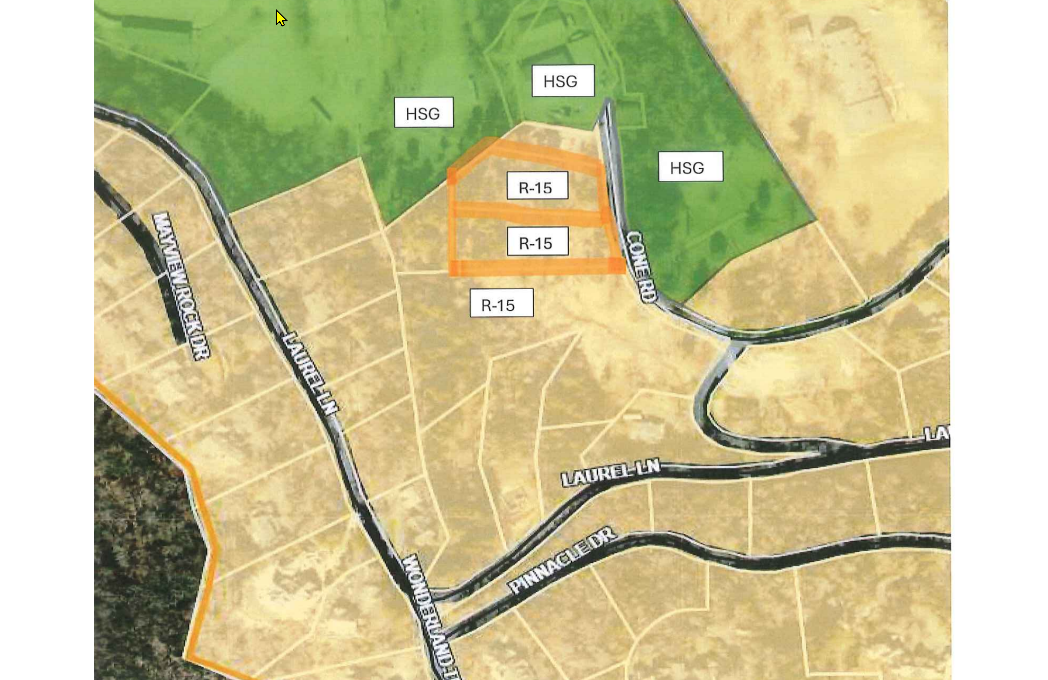
By David Rogers. BLOWING ROCK, N.C. — For at least a short while, individual vs. community benefit became a focus of the Blowing Rock Town Council’s regular June meeting, but by 4-1 vote the board of commissioners approved the Bennett family’s request to rezone two parcels they own between their house and the Blowing Rock Horse Show Grounds complex. The rezoning from R-15 (residential) to HSG (horse show grounds) enables the Bennetts to build a small barn in which to house a couple of horses.
While the lone dissenting commissioner, David Harwood, sought to have clarified what uses an “HSG” zoning permitted that might be detrimental to the community, as a whole, ultimately the other four commissioners were convinced that any risk of adverse consequences is minimal given the 102-year history of the Blowing Rock Charity Horse Show next door to the Bennett’s property.
Parcels outlined were subject of the rezoning request by the Bennett family at the June 10 meeting of Town Council.
Harwood cited Section 16-23 of the Land Use Code in advancing a first motion to deny the application.
“In looking at Section 16-23, it is really clear that we can’t make this decision based on whether the change will help or hurt the private owner of this property. We really have to make this decision based on how the change will affect the whole community and not take into account Mr. and Mrs Bennett’s advantages or disadvantages in this. In my opinion, the private use of this (rezoning) is inconsistent with the public use of HSG,” said Harwood.
Harwood’s motion to deny the application did not receive a second, so did not go any further.
Editor’s Analysis: Harwood raised an interesting issue since Section 16-23.6.1 reads, “When considering proposed map amendments, the Board shall not consider any representations made by the petitioner that, if the change is granted, the rezoned property will be used for only one of the possible ranges of uses permitted in the requested classification. Rather, the Board shall consider whether the entire range of permitted uses in the requested classification is more appropriate than the range of uses in the existing classification.” (Emphasis added)
While the Bennett’s stated goal is to build a small barn to house a couple of horses, among the potential uses of a property zoned HSG, for example, are the erection of various types of communication towers, staging of special events, or the temporary sale of merchandise. That said, each of those uses requires an HSG property owner to obtain either a Zoning Permit or a Special Use Permit from the Town, so approval of those uses is not automatic.
In addition, the opening paragraph of Section 16-23.6 advises the board of commissioners that the central issue before the Board is whether the proposed amendment to the Land Use Code is consistent with the town’s Comprehensive Plan or any other adopted plan. Given the 102-year history of the Blowing Rock Charity Horse Show, the rich equestrian history of the Town of Blowing Rock, generally, the adjacency of the Bennett’s parcels to the horse show grounds and that any other use requires a Zoning Permit or a Special Use Permit, the 4-1 approval of this application seems appropriate.
Parking Enforcement Public Hearing
Based on direction from the Board of Commissioners at its regular May meeting, Police Chief Nathan Kirk presented proposed changes to the various ordinances regulating parking in the downtown area. The proposed changes included reducing the time limit on all public streets, including Main Street, from three hours to two hours, as well as proposed regulating the time frames for parking on the Maple Street lot (to three hours) and adjusted the fines (increased) for parking violations and failure to pay. At the end of the public hearing, none of the hourly limits were changed, but the fines were increased and the hours of enforcement were modified.
Kirk presented data showing that there are 253 parking spaces (including the 56 spaces in the Maple Street lot) on the seven primary streets downtown, as well as 280 parking spaces in public, off-street parking (i.e. American Legion decks, BRAHM, Broyhill Lake, etc.).
Presenting additional descriptive information about and from parking enforcement and administration vendors, T2 Systems and Passport, Kirk offered the Council members insight into how parking enforcement in today’s Blowing Rock can be carried out effectively, with advantages to the enforcement officers, the police administrators, the town and the people parking their cars downtown, including potential violators. He also outlined the initial and ongoing costs for administering the enforcement system.
During the public hearing, the commissioners heard from Robin Miller, CEO of the Blowing Rock Chamber of Commerce, who offered collective feedback from the more than 140 member business owners she had surveyed.
Town Manager Shane Fox clarified that except for the Maple Street lot, the town would not be changing the enforcement area from what it is currently, just changing the enforcement structure (how they enforce and hourly changes).
After some discussion, Commissioner Melissa Pickett moved to increase the monetary fines for violations, to purchase the software and equipment, change the enforcement times to 9 a.m. to 5 p.m., Monday through Saturday, and Sunday 1 p.m. to 5 p.m., and leaving the time limits the same. The motion passed, unanimously.
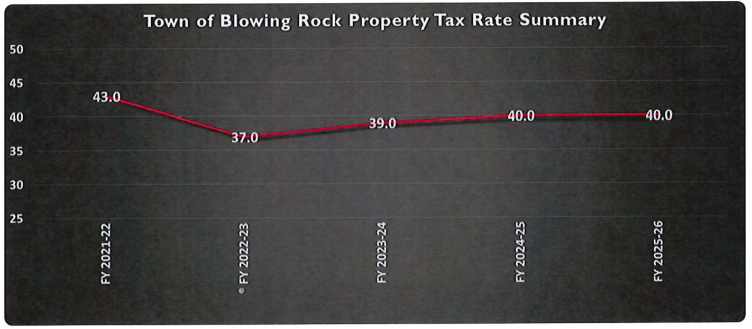
With the new budget, Blowing Rock property taxes will remain the same.
Town Budget Public Hearing
Shane Fox presented the proposed 2025-26 Town Budget, assembled initially by town staff with tweaks, changes, additions and deletions during the course of budget workshops with the mayor, commissioners, and department heads.
Highlights:
No property tax increase
Diversified revenue sources between property taxes, sales taxes (slight increase) and TDA occupancy taxes (steady)
Salaries will see a 2.5 percent cost of living increase
6% increase in Retirement
5% increase in Health Insurance
Debt payment is flat, but total debt is shrinking
Continuation of the Capital Plan
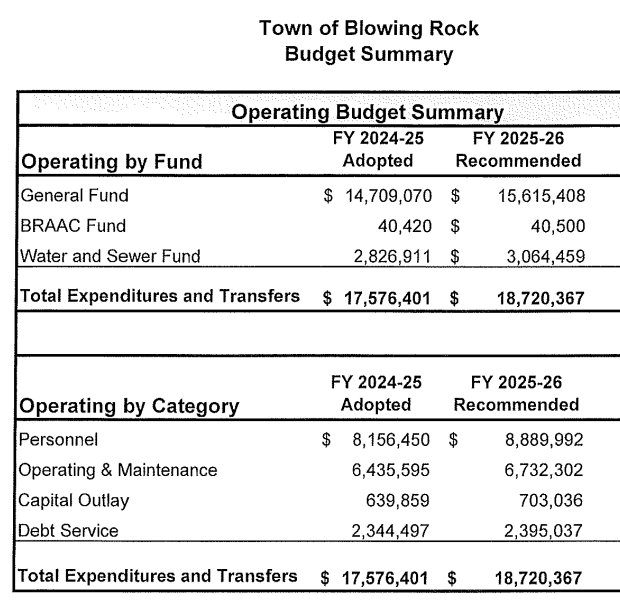
Budget Summary, courtesy of The Town of Blowing Rock
Other Notes:
Fox presented an analysis expecting approximately $1.75 million in property tax revenue in FY2026, up from $1.69 million in FY2025, with a flat rate reflecting the addition of new construction during the year.
Sales tax expectations are for a 10 percent increase, to $3.63 million.
The town staff is cautious on TDA revenue expectations, budgeting for occupancy taxes to be “flat”, at $2.4 million (same as the current year).
TDA was on track for a record year until Hurricane Helene.
TDA gives one-third of occupancy taxes to the Town, or roughly $600,000. The rest is earmarked for tourism-related expenses and promotion, per state regulations. (Note: in 2021-22, the Town’s one-third allocation was $321,000)
The Town’s one-third goes toward expenses relating to U.S. 321 landscaping, park attendants, Christmas decorations, streetlights, sidewalks, parking deck, new bathrooms, new playground, Memorial Park renovations, etc.
Because of relatively high amount of revenues received from TDA (tourism), visitor spending is estimated to save each Watauga County property taxpayer $649 per year.
General Fund Fees
Review of final construction plans will increase from $200 to $500.
No other changes to Planning and Zoning fees.
Monthly recycling charges will increase from $10 to $12 per month.
No changes to Parks & Recreation fees
No changes to Cemetery fees
No other changes in General Fund fees
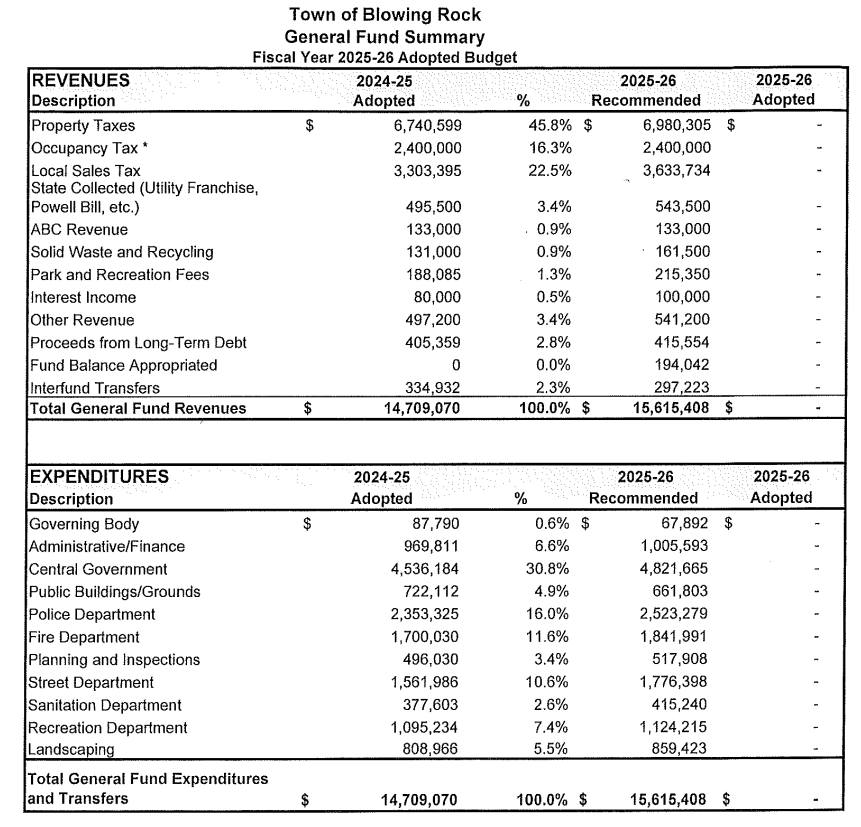
Expenditures are budgeted for $5.96 million, an increase of $277,000, mostly explained by the portion of Sales Taxes reimbursed to Watauga County on increased revenue forecasts and increases in legal, audit and information technology-related expenses.
Expenditures, by department
30 percent – Public Safety
29 percent – Central Government
14 percent – Streets & Sanitation
11 percent – General
7 percent – Parks & Recreation
5 percent – Landscaping
3 percent – Planning & Zoning
Expenditures, by Type
38 percent – Operating Costs
30 percent – Salaries
18 percent – Benefits
11 percent – Debt Service
3 percent – Capital Outlay
Capital Outlays are budgeted for a slight increase over FY2025, to $415,554, for replacement costs in all departments, from police to streets & sanitation and parks & recreation.
Capital Outlay needs listed included final one-half of finance software (Administration), one police vehicle (Public Safety), chipper truck (Streets), dump truck (Streets), snow plows (Streets) and cameras (Streets), 2 “minis” (Landscaping) and golf cart for Gator (Landscaping).
Salaries and Benefits
Cost of Living (COLA) increase of 2.5 percent ($120,000)
Retirement and Health Insurance increases of $346,000
Total Salaries & Benefits budgeted = $7.49 million
No new full-time positions are expected.
Benefits include medical, dental, vision insurance at little or no cost to the employee, as well as life insurance and a 5 percent 401K match. Blowing Rock Academy (child care) discount.
Area comparables for Salaries and Benefits:
Blowing Rock (48 percent of General Fund Budget)
North Wilkesboro (51 percent)
Boone (57 percent)
Hickory (60 percent)
Debt
Blowing Rock has a AA+ credit rating or its equivalent with all three major rating services (Moody’s, Standard & Poor’s, and Fitch), which is the highest possible credit rating for a town of Blowing Rock’s size.
At 0.55 percent of appraised (property) value, Blowing Rock compares favorably with other towns and cities in North Carolina.
According to the state’s Legal Debt Limit calculation, Blowing Rock is permitted to have debt of more than $133.6 million. Blowing Rock’s current debt levels are trending down, budgeted for $8.96 million in FY2026, down from $10.03 million in FY2025 and $11.09 million in FY2024.
Fund Balance is balanced, utilizing $194,000 in Fund Balance after $800,000 was added to Fund Balance subsequent to the June 30, 2024 audit.
Water & Sewer
Proposed 7 percent increase in rates
Operating cost are up (chemicals and materials).
Meters are installed and $156,000 in debt is included.
Water & Sewer capital needs include a backhoe, a truck, and a leak detection system.
Public Comments
Local resident Janie Sellers, identifying herself as an officer of the Blowing Rock Civic Association, offered thanks for not raising property taxes then recalculated the net revenue sources to suggest that property taxes account for 57 percent of the town budget (instead of the 45 percent presented by Town Manager Shane Fox) after the legally mandated redistributions of sales taxes and occupancy taxes to Watauga County and the TDA, respectively.
(Editor’s Note: Town Manager Shane Fox has previously explained at town council meetings and in interviews with Blowing Rock News that the Town’s calculations presented in the report are what is legally mandated by the state. Sellers’ calculation, which is similar to what other BRCA members have presented in previous years, does not conform to the state-mandated calculation. The sales tax and occupancy tax distributions are contracted operating expenses, just like other operating costs. If a critic was to exclude other expense line items, in addition to the ones noted by Sellers and the BRCA, they could eventually get to a much higher percentage contribution from property taxes, even though it would be similarly non-conforming).
Sellers also asked that more detail be provided for some of the reported operating costs and comparable data, and that the budget information be made publicly available much earlier in the planning and approval process.
Local resident Jenny Miller, the former CEO of a large non-profits agency, thanked the town staff and the commissioners for their hard work in preparing the budget and appreciated the detail and explanations offered in the presentation. She suggested that because the information has been made available in advance of the public hearing, far fewer people attended the council meeting than might otherwise be expected. Miller also recalled hearing complaints from some residents about “how high” their property taxes are in Blowing Rock. She noted that the property tax rate of 40 cents is low and made possible by the diverse revenue sources, including sales taxes and occupancy taxes, as well as the high property valuations because the properties are in Blowing Rock and not elsewhere. “If you think this low tax rate is too high in Blowing Rock, you can always move to Sparta or down the mountain.”
After the public hearing was closed, the Board of Commissioners moved quickly to approve the budget as presented, unanimously.
NOTE: Our presentation of the budget information is intended solely to extract what we feel are key highlights. For a more comprehensive review of the presentation, as well as to review all discussion regarding the other issues, please click on the YouTube video link of the June 10 meeting of Town Council HERE.
General Fund Summary of Revenues and Expenses, FY2025-26, courtesy of The Town of Blowing Rock
By David Rogers. NEW YORK, N.Y. (remote) — High Country-based professional athlete Amanda Vestri was at the front for most of the 2025 Mastercard New York Mini 10k on June 7, leading 9,962 women and girls in winding through the ups and downs of Midtown Manhattan and Central Park. It was Kenya’s Helen Obiri and Weini Kelati, though, who surged ahead in the final two miles to capture the No. 1 and No. 2 spots, respectively, just five seconds separating the two. Obiri broke the tape in 30:44, with Kelati close behind in 30:49.
Vestri fought hard to stay in contention, but faded to No. 6, only 36 seconds behind Obiri in 31:20. A member of Blowing Rock’s ZAP Endurance elite running team, Vestri was the second American to cross the finish line, just 21 seconds behind Taylor Roe, the former Oklahoma State University track and cross country star now hailing from Raleigh, N.C.
Boone and Blowing Rock’s Amanda Vestri ran at the front of the lead pack for most of the Mastercard New York Mini 10K road race on June 7. Photo by Janet Klutch, courtesy of ZAP Endurance
Vestri was the top American finisher in 2024, No. 4 overall (31:17).
“Amanda ran an exceptional race, banging heads with some of the best women on the pro circuit,” said ZAP Endurance head coach Pete Rea. “This performance sets her up well for next weekend’s U.S. 4-Mile Championship, on June 14 in Peoria, Illinois.”
Roe was making her Mastercard Mini debut after recently breaking the women-only 10-mile world road race record in 49:53, in Washington, D.C. on April 6. Her 30:58 in the Mastercard Mini is a new personal best at the 10K road distance.
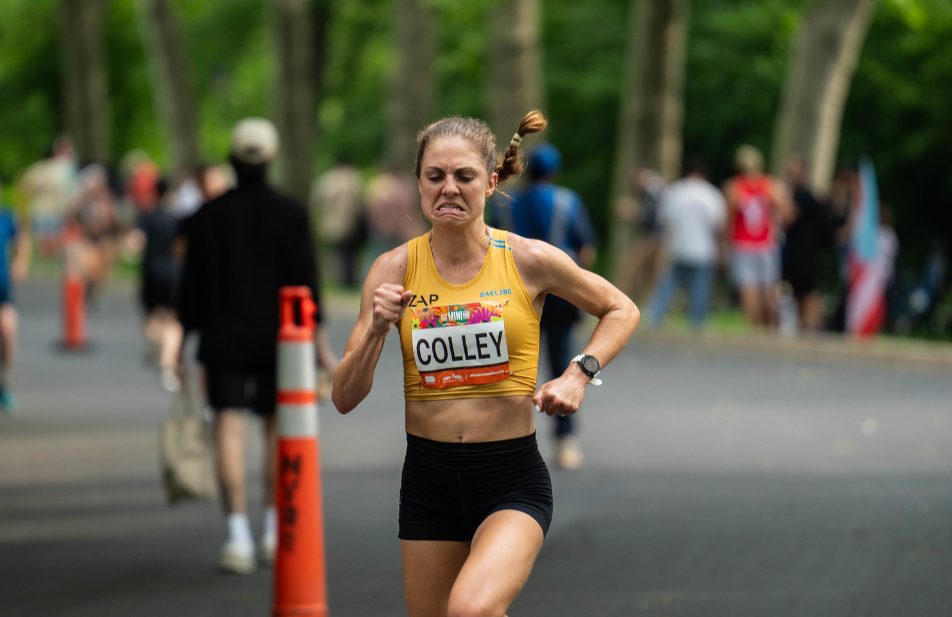
The High Country was well represented in this race around Central Park and beyond. Another ZAP Endurance team member, Tristin (Van Ord) Colley, finished at No. 25 (33:34), her first race since the iconic Boston Marathon on April 21, where she finished No. 19 among the 12,210 women competing over the 26.2 miles of Beantown streets.
“Tristin had a good, solid run for her first race coming off the Boston Marathon in April. The summer is looking good for her on the U.S. road racing scene.”
Former App State track and cross country star Tristin (Van Ord) Colley works hard toward the finish of the Mastercard New York Mini 10K road race on June 7, 2025, in Central Park. Photo by Janet Klutch, courtesy of ZAP Endurance
The Mastercard New York Mini 10K is the world’s original, women-only race to feature Olympians and World Championship medalists. The race was first organized in 1972, by the New York Road Runners, as a way to promote women’s distance running, generally. The race’s inaugural sponsor was Johnson Wax, promoting a women’s shaving gel called, “Crazylegs.” Only 78 runners competed in the first race, but in the last 50 years it has grown to be both an elite running event as well as a “fun run” for many female athletes.
The 1972 first race was won by Jacqueline Dixon of the U.S., in 37:17. The course record is 30:12, set in 2023 by Senbere Teferi of Ethiopia.
The course of the road race begins near 61st Street on Central Park West and heads north, entering Central Park at West 90th Street. The route loops in a clockwise direction, turning southwards at Harlem Meer around the 3-mile (5-kilometre) mark. It continues south past the Central Park Reservoir and the Guggenheim Museum. Runners continue southwards until they come towards the park’s limits near Wollman Rink at which point it heads to the west and turns north to the finishing point near the Tavern on the Green and Sheep Meadow.
Of the almost 10,000 runners, 7,169 of them were from one of the five New York boroughs, with 2,804 coming from outside of NYC.
Manhattan: 3,892
The Bronx: 312
Brooklyn: 1,605
Queens: 1,240
Staten Island: 120
The youngest finisher was 3-yearold Oliver Marks, in 57:57. The oldest was Ulrike Klopfer, in 1:55:06, according to the New York Road Runners.
GENEVA, Ohio — By placing eighth in the 65 kg division of the U23 Freestyle Nationals, App State’s Jarvis Little became the seventh USA Wrestling All-American in the last four years from Boone RTC.
Little, who redshirted as a true freshman at App State during the 2024-25 season, won six of his first seven matches in Ohio and finished 6-3 in the event.
After going 4-1 on the opening day, Little reached the final 12 in his bracket with a 5-4 victory over Gable Porter from Virginia. Porter recorded a tying takedown with 12 seconds left in the final period, but Little broke the tie with a reversal two seconds later and stayed on top to finish the match.
Little then clinched All-America recognition and a top-eight finish by advancing over an opponent who had been disqualified from a quarterfinal match in the previous round.
Little won his first three matches in decisive fashion before dropping into the consolation bracket with a 7-2 loss. After clinching a top-eight finish, he dropped a 9-6 decision against Northern Iowa’s Connor Thorpe to set up a match for seventh place against Noah Tolentino from Oregon State. Little jumped out to a 4-0 lead, but Tolentino rallied for a 5-4 victory.
Boone RTC had three wrestlers reach the final 24 in their brackets before being eliminated with a second loss: Colby McBride (57 kg), App State newcomer Joe Fongaro (65kg) and Joe Zovistoski (79kg).
McBride reached the Round of 16 with a 2-0 start before dropping his next two matches. Fongaro started 2-0 and was 4-1 before falling against Little, while Zovistoski followed an opening loss with five straight victories before finishing 5-2.
Kaden Keiser (four wins), Logan Eller (four wins), Bryson Terrell (two wins) and Anthony Conetta (two wins) all prevailed in Consolation Round 4 matches before being eliminated. Brayden Fahrbach, Alex Hopper and Stephan Monchery also won at least two matches.
Jarvis Little’s results
Champ. Round 1: Jarvis Little, BORT over Donnie Morton, PVWC (TF 10-0 (1:47) )
Champ. Round 2: Jarvis Little, BORT over Kayd Craig, BRUV (Dec 8-2 )
Champ. Round 3: Jarvis Little, BORT over Ethan Qureshi, SCRT (Dec 10-4 )
Champ. Round 4: Nash Singleton, BDWR over Jarvis Little, BORT (Dec 7-2 )
Cons. Round 6: Jarvis Little, BORT over Joe Fongaro, BORT (TF 10-0 (1:11) )
Cons. Round 7: Jarvis Little, BORT over Gable Porter, CWC (Dec 5-4 )
Cons. Round 8: Jarvis Little, BORT over Jager Eisch, MIRT (DQ )
Cons. Round 9: Connor Thorpe, PWCR over Jarvis Little, BORT (Dec 9-6 )
7th Place Match: Noah Tolentino, BDWR over Jarvis Little, BORT (Dec 5-4 )