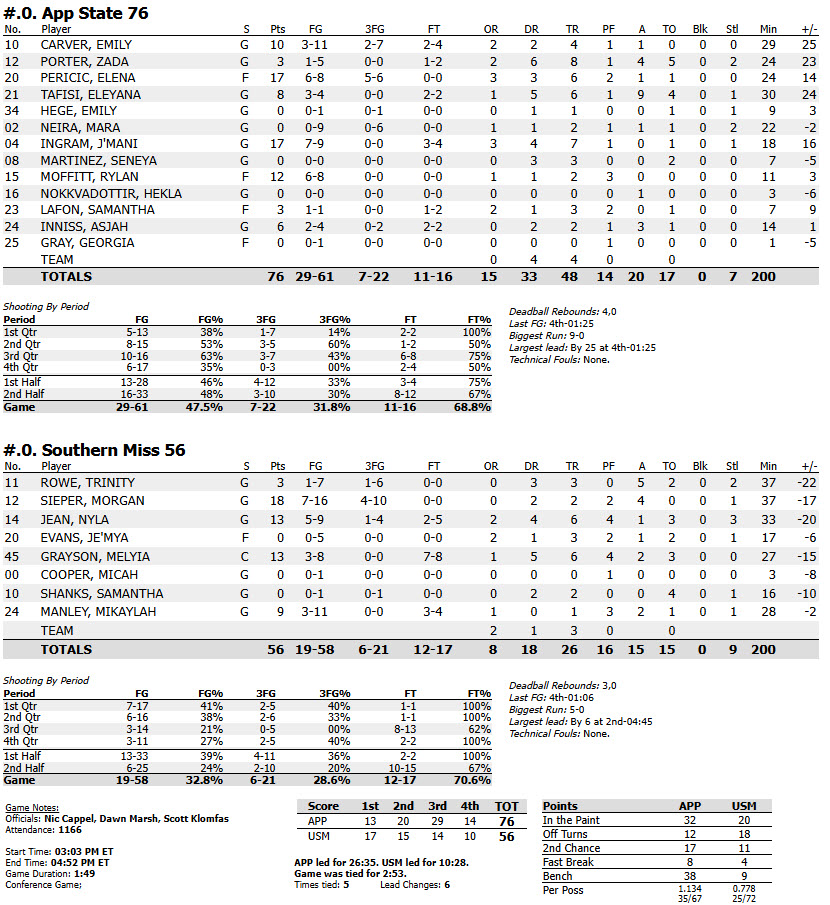
By Katherine Jamtgaard. HATTIESBURG, Miss. — The App State women’s basketball team defeated Southern Miss, 76-56, in Hattiesburg, Miss., on Jan. 4. The win marked the Mountaineers’ first victory over Southern Miss in program history, only having met the Lady Eagles three times in this millennium.
App State rises to 3-0 in Sun Belt play as well as 7-6 on the season. This is the Mountaineers’ first ever 3-0 start in Sun Belt play and first 3-0 start in conference games since 2011-12, when the team competed in the Southern Conference (SoCon).
“We are really proud of our team for completing the road sweep,” said head coach Alaura Sharp. “We challenged our team to win this game with their defense and they did just that. Our second half defense was really composed and we attacked the glass hard. We are really showing our growth as a unit.”
A quartet of Mountaineers netted double-figures, led by junior Elena Pericic and senior J’Mani Ingram, each scoring 17 points. Pericic knocked down five-of-six from beyond the arc, accounting for all but two of App State’s treys, and grabbed six rebounds. Ingram drained 7-of-9 from the field and 3-of-4 from the charity stripe in addition to pulling down seven rebounds. Junior Rylan Moffitt netted 12 points while senior Emily Carver scored 10 points.
App State’s top rebounder for a second consecutive game —and fourth game this season — was senior Zada Porter, who grabbed eight rebounds. Fellow senior Eleyana Tafisi dished out a team high nine assists, coming within one of her career high of 10, originally set on March 7, 2024.
App State recorded 38 points by its reserves while holding Southern Miss to nine bench points. The Mountaineers also netted 17 second chance points compared to Southern Miss’ 11. App State limited Southern Miss to eight offensive rebounds and four fastbreak points. Over the course of play, App State and Southern Miss knotted the score on five occasions, swapping the lead six times.
Tafisi put the Mountaineers on the board with a fastbreak layup in the paint, which Porter followed up with a layup of her own. Pericic drilled her first trey of the game to extend App State’s lead to 7-2. The Mountaineers and Lady Eagles knotted the score thrice before Southern Miss broke an 11 all tie to take a 14-11 lead. Despite a jumper from Pericic, Southern Miss closed the first period ahead, 17-13. Pericic and Tafisi had combined for 11 of App State’s 13 points in the first quarter.
Pericic opened the second quarter with a 3-point bucket to bring the Mountaineers within one (17-16), but the Lady Eagles answered with a trey of their own. A layup from Moffitt and another Pericic 3-pointer kept the Mountaineers within one of Southern Miss’ lead (22-21). Midway through the quarter, App State faced a scoring drought as Southern Miss extended the deficit to 27-21. Carver knocked down a trey for the Black and Gold and, coming off the bench, Ingram went to work accumulating eight points in four minutes, knocking down 4-of-4 from the field. App State entered halftime with a 33-32 edge over the Lady Eagles. The Mountaineers shot 60% from the arc and 53.3% from the field in the second quarter.
Southern Miss edged ahead, 34-33, after opening the third quarter with a jumper. The Mountaineers answered with a 9-0 run that featured treys from Carver and Pericic as well as a tip-in basket from Ingram. The trio combined for 18 of App State’s 29 points in the period. Ingram extended the lead to 46-35 after sinking a pair of freebies and making a layup in the paint. With layups from Tafisi and Moffitt, App State reached a 50-37 lead. Jumpers from Moffitt and senior Asjah Inniss, a Pericic trey, a Carver layup, and a pair of Inniss freebies brought the Mountaineers to a 61-42 lead. Senior Samantha LaFon contributed a free throw as the Mountaineers took a 62-46 lead at the end of the quarter.
Ingram opened the fourth quarter with a freebie, which she followed with a jumper. Moffitt netted six points for the Mountaineers over 1:38, draining a pair of jumpers and making a tip-in basket. With a LaFon layup, Carver free throw, and Inniss jumper, App State took its biggest lead of the game, 76-51. Despite a Southern Miss trey and pair of free throws, the Mountaineers took the win, 76-56, notching their fourth consecutive victory since Dec. 21.
Up Next
The Mountaineers return to Boone to host Troy at noon on Jan. 9 for their Education Day game. Admission for all fans is free for Thursday’s game.
On Jan. 11, App State hosts Coastal Carolina at 3:30 p.m. as part of a doubleheader with the men’s basketball program. The men’s team will play James Madison at 1 p.m. Fans are encouraged to come early for the men’s game and stay late for the women’s game, as one ticket will get fans into both games. The doubleheader will also be the Mountaineers’ “stripe out,” in which fans are encouraged to wear either black or gold depending on the section their seats are in.
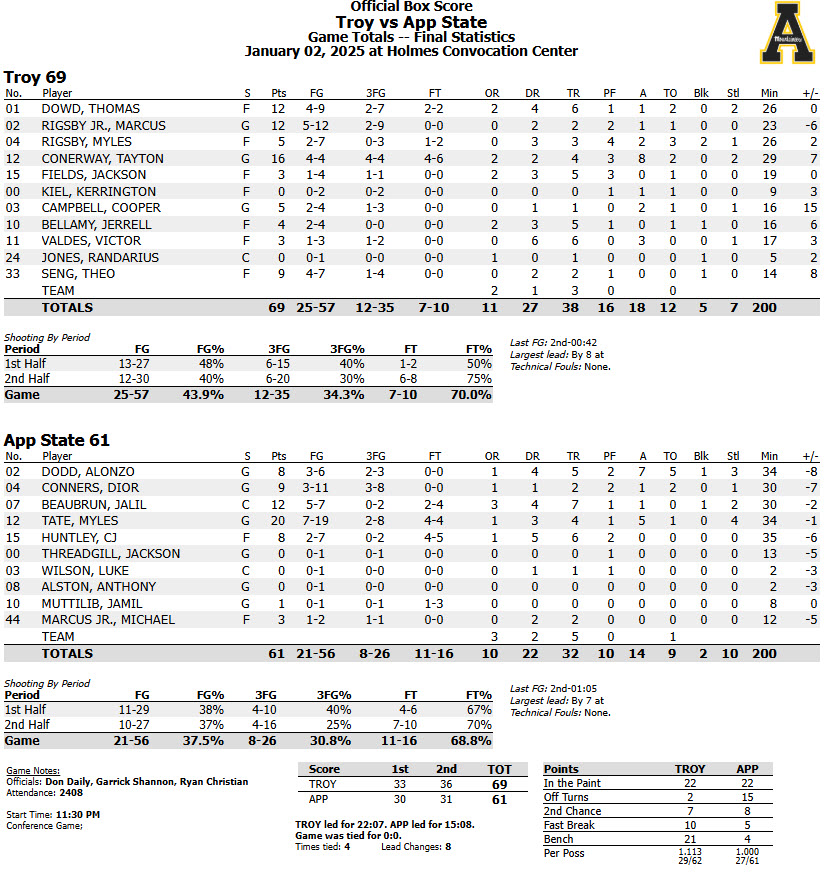
By David Rogers. BOONE, N.C. — In what evolved as a back and forth contest between host App State and visiting Troy on Jan. 2, in front of 2,406 basketball fans at the Holmes Convocation Center, it was a one-point basketball game with under three minutes to play. But with the clock winding down, the Trojans made “big time plays in big moments” and the Mountaineers didn’t. Result: Troy 69, App State 61.
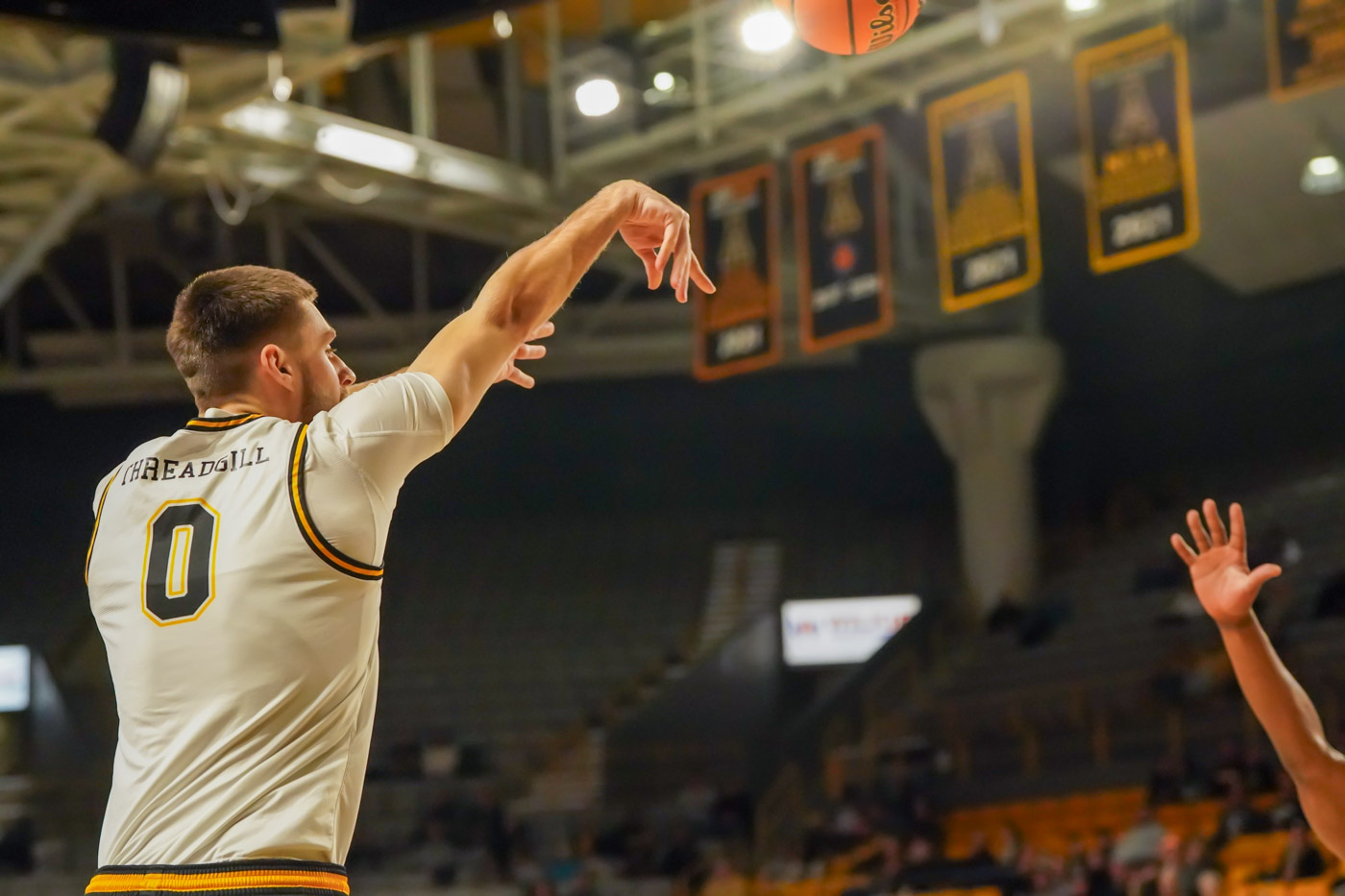
Guard Jackson Threadgill puts up a shot vs. Troy on Jan. 2. Photographic image by David Rogers for High Country Sports
Now 6-7 overall and 0-2 in the young Sun Belt Conference season, App State is playing exciting basketball, with thrills, spills and hustle aplenty. The Mountaineers just aren’t finishing. They have now lost four nailbiters in a row to some very good Division I teams: High Point, at Louisiana, at North Texas and back home vs. Troy. In crunch time, the shots just aren’t falling, even with open looks.
Going into the Jan. 2 matchup, Troy’s reputation included a pesky defense that forced a lot of turnovers, one of the top 40 teams in that department out of 355 Division 1 programs, according to the NCAA maintained statistics. The Mountaineers were able to thwart that supposed strength, only guilty of nine turnovers on the night vs. 12 committed by the Trojans. Advantage: Mountaineers.
Troy also had a reputation as a good 3-point shooting team. Against App State, they were 12-of-35 from beyond the arc (34.3 percent).
“We can live with that,” App State head coach Dustin Kerns pointed out after the game. “You have to credit Troy. They are a good team. Tonight they hit big time shots at the big moments and we didn’t.”
The Sequence
App State forward Jalil Beaubrun on a power dunk in the first half on Jan. 2, vs. Troy. Photographic images by David Rogers for High Country Sports
Although the Mountaineers held a 15-2 advantage in points off the opposing team’s turnovers, where they faltered was offensive production from the bench. Troy’s reserves outscored App State’s reserves, 21-4.
Among the Mountaineer starters, guard Myles Tate earned game-high scoring honors with 20 points, but only one teammate got into double figures, scoring. That was forward Jalil Beaubrun’s 12 points while also posting a team-high 7 rebounds.
Troy had three players in double figures scoring, including guard Tayton Conerway (16 points), forward Thomas Dowd (12) and guard Marcus Rigsby, Jr. (12).
The Trojans also played spoiler in the paint, with five blocks.
App State will look to get back in the scoring column on Saturday, Jan. 4, in a 1 p.m. tilt vs. Texas State at the Holmes Center. They follow with two additional home games before going back on the road, Wednesday, Jan. 8 vs. Coastal Carolina (6:30 p.m.) and Saturday, Jan. 11 vs. James Madison (1 p.m.).
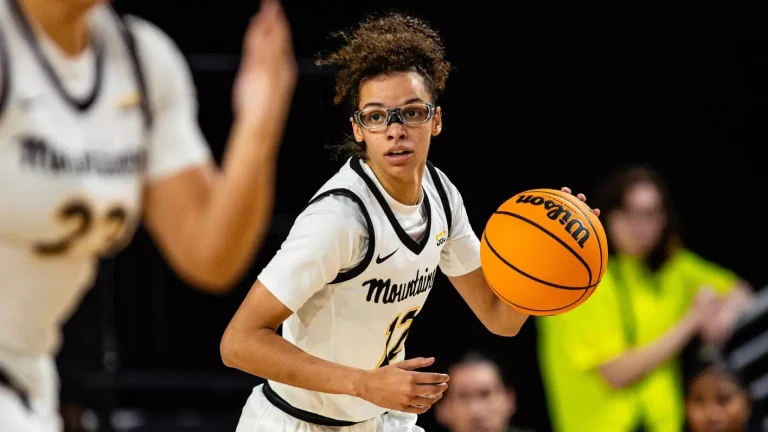
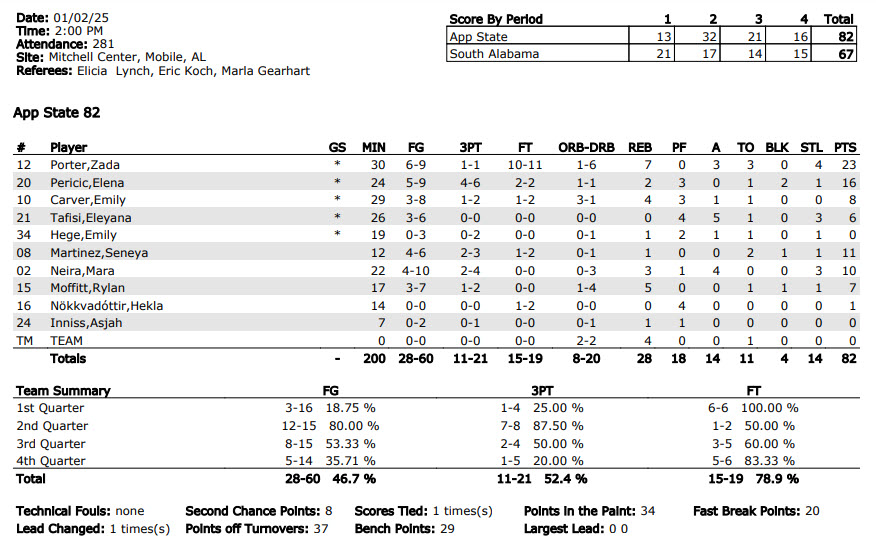
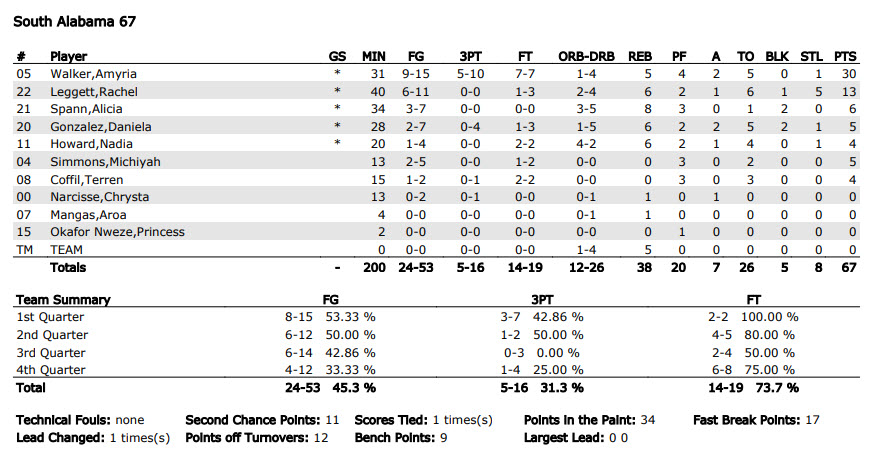
By Katherine Jamtgaard. MOBILE, Ala. — The App State women’s basketball team defeated South Alabama, 82-67, on Thursday in a road matinee matchup. The victory marked the fourth consecutive win for the Mountaineers in the series against South Alabama and third consecutive win for App State since Dec. 21. The Mountaineers are 2-0 in Sun Belt action and improve to 6-6 on the season.
“I’m really proud of our team for fighting back in the first half,” said head coach Alaura Sharp. “We dug a big hole and showed great stick-with-it attitude to come back to take the lead before halftime. Learning to handle that kind of adversity is really important for a team. We played really hard and are showing signs of growth.”
Four Mountaineers netted double figures, led by senior Zada Porter, who scored a career high 23 points. Her previous career high was 16 points, set against Wofford on Dec. 7. Porter knocked down 10-of-11 from the charity stripe as well as 6-of-9 from the field. She also grabbed a team high seven rebounds, dished out three assists, and matched her career high four steals for a second time this season. Junior Elena Pericic netted 16 points, knocking down 4-of-6 from the arc. Additionally, Pericic made two of App State’s four blocks. Fellow junior Seneya Martinez and senior Mara Neira netted 11 points and 10 points, respectively, and combined for four of App State’s 11 treys. Senior Eleyana Tafisi dished out a team high five assists.
Porter shot 100% from the charity stripe, knocking down all six of her freebies.
App State shot 52.4% from the arc, 78.9% from the line, and 46.7% from the field. The Mountaineers netted 37 points off turnovers compared to South Alabama’s 12. The Black and Gold also netted 29 points off the bench compared to the Jaguars’ nine. App State caused 26 South Alabama turnovers and held the Jaguars to five treys over the course of play.
Despite a slow start for the Mountaineers in the first quarter, Porter and Neira combined for 11 of App State’s 13 points. Porter shot 100% from the charity stripe, knocking down all six of her freebies. Neira knocked down the Mountaineers’ first trey of the game as well as a second-chance jumper.
App State shot better than 50% from beyond the arc and almost 80% from the charity stripe.
The Mountaineers found their stride in the second quarter, despite trailing, 21-13. Pericic opened the quarter with a 3-point bucket, which Porter followed with a layup to cut the deficit to 21-18. Back-to-back 3-pointers from Porter and Martinez brought App State to within one of South Alabama’s lead (24-23). Junior Rylan Moffitt knocked down a trey of her own to push the Mountaineers ahead, 26-24. South Alabama knotted the score at 26-26 for the only tie of the game, but then broke the tie with a Tafisi layup and maintained control and the lead for the remainder of play.
Neira and Martinez knocked down another pair of treys to extend App State’s lead of 34-29. Martinez made another layup, netting all 11 of her points in the second quarter. With another Tafisi layup and a second Pericic trey, App State took a 45-31 lead. Over the course of the period, App State shot 87.5% from the arc, 80% from the field, and outscored South Alabama, 32-17.
Early in the third quarter, Porter sank another pair of freebies before Pericic knocked down back-to-back 3-point buckets for a 53-38 lead. Building off layups from Pericic, Porter, senior Emily Carver, and Moffitt, in addition to a freebie from freshman Hekla Nökkvadóttir, App State maintained a 66-50 lead at the close of the quarter.
Tafisi opened the fourth quarter with a layup, which Pericic followed up with a pair of free throws to keep the Mountaineers ahead, 70-55. Despite an early scoring drought, Porter sank another set of freebies. Carver also contributed a point from the charity stripe before Porter made a second-chance layup on a fastbreak. Carver knocked down her sole trey of the game to put App State up, 78-64. Neira and Porter made a last pair of layups before sealing the win, 82-67.
Up Next
The Mountaineers will head to Hattiesburg, Miss. to take on Southern Miss on Jan. 4. Tipoff is set for 3 p.m. ET (2 p.m. CT) and the game will be available to stream on ESPN+.
Special Report. BOONE, N.C. — App State alum D.J. Smith, a championship-winning player and coach during his previous tenures on the mountain, has been tabbed as the program’s next defensive coordinator by new head coach Dowell Loggains.
One of the best linebackers in school history who also played four years in the NFL, Smith spent the past five seasons on Eliah Drinkwitz’s Missouri staff, including the last three as co-defensive coordinator and recruiting coordinator.
“We are very excited to welcome D.J. and his family back to Boone,” Loggains said. “D.J. played, coached and recruited for elite defenses at the highest levels of football. As an App State alum, he understands the championship tradition and standard of excellence here on the mountain.”
Smith helped Mizzou make bowl appearances in each of the last four seasons. The Tigers were led by a top-25 scoring defense in each of the last two years on their way to a 20-5 record entering Monday’s Music City Bowl.
“I’m excited and honored to come home to App State,” Smith said. “App is a special place with special people. This is where my collegiate career started as a player and as a coach. I appreciate Coach Dowell and Doug Gillin for entrusting me with this opportunity to return and lead this defense. Can’t wait to get started and continue the traditions of App State. It’s always a great day to be a Mountaineer!”
In 2024, Smith’s linebackers helped Missouri boast a top-20 scoring defense (19th, 20.1 points per game) and total defense (20th, 319.3 yards per game) as one of the SEC’s best units.
Smith’s 2-year tenure as App State’s outside linebackers coach coincided with two of the best seasons in school history.
Missouri’s defense was 25th nationally allowing 20.8 points per game en route to an 11-2 season in 2023. Smith’s pupil, Ty’Ron Hopper, earned All-SEC honors, was a Butkus Award finalist for the nation’s best linebacker and was chosen in the third round (No. 91 overall) of the 2024 NFL Draft by the Green Bay Packers.
Smith also mentored one of the nation’s best linebackers and one of the most decorated in Missouri history in his first year in Columbia. Nick Bolton led the SEC with 67 solo tackles in 2020 on his way to second-team All-America recognition (from six different outlets) and first-team All-SEC honors. He was named a Butkus Award finalist, a Jason Witten Man of the Year semifinalist and a member of the SEC Community Service Team before being selected in the second round (No. 58 overall) of the 2021 NFL Draft by the Kansas City Chiefs.
Smith helped Mizzou to bowl appearances in each of the last four seasons.
Smith’s two-year tenure as App State’s outside linebackers coach coincided with two of the best seasons in school history. The Mountaineers won 24 of 27 games during that span under two different head coaches and defensive coordinators, with the defense ranking fourth in the country in scoring in 2018 (15.5 points per game) and 21st in 2019 (20 points per game).
Working under Drinkwitz in 2019, Smith helped lead the Mountaineers to a Sun Belt Conference title with a 12-1 overall record and a No. 20 national ranking before being hired at Missouri, prior to App State’s win in the 2019 New Orleans Bowl.
Smith’s outside linebackers were a big reason why App State won the first two Sun Belt Championship games in 2018 and 2019. Akeem Davis-Gaither, who is currently a team captain with the Cincinnati Bengals, was the 2019 Sun Belt Defensive Player of the Year, while Noel Cook earned All-Sun Belt honorable mention. Davis-Gaither and Cook also earned all-league recognition in 2018.
Throughout his first four years after returning to the staff at his alma mater, App State amassed a 42-10 overall record, won or shared four-straight Sun Belt championships, and went a perfect 4-0 in bowl games. He joined Scott Satterfield’s staff in 2016 as the director of recruiting relations and worked in 2017 as a senior defensive analyst.
Smith amassed 525 tackles as an App State linebacker from 2007-10 and played four NFL seasons.
A Charlotte native, Smith started the final nine games of App State’s 2007 national championship run as a true freshman and had more than 120 tackles in each of his four college seasons, including two in which he earned All-America recognition. He finished his career with 50 straight starts and ranks second behind only Dexter Coakley on the App State career tackles list.
A sixth-round draft pick by the Green Bay Packers in 2011, he made three starts in 16 games as a rookie and started six more games the following year. He totaled 82 tackles, two sacks and one interception with the Packers before spending time with the San Diego Chargers, Carolina Panthers and Cleveland Browns from 2013-14.
Smith and his wife, Charla, are parents to a son, Carter.
SMITH AT A GLANCE
Alma Mater: App State, 2010
Hometown: Charlotte, N.C.
Wife: Charla
Son: Carter
Twitter: @CoachDjSmith
Coaching Experience
2015: Vance H.S. (Defensive coordinator)
2016: App State (Director of recruiting relations)
2017: App State (Senior defensive analyst)
2018-19: App State (Outside linebackers)
2020-21: Missouri (Linebackers)
2022-24: Missouri (Co-Defensive coordinator/linebackers)
Playing Experience
2007-10: App State (LB)
2011-12: Green Bay Packers (LB)
2013: Houston Texans (LB)
2014: Carolina Panthers (LB)
Bowl/Postseason Experience
Coach
2016: Camellia (App State)
2017: Dollar General (App State)
2018: New Orleans (App State)
2019: New Orleans (App State) – did not coach in the game
2021: Armed Forces (Missouri)
2022: Gasparilla (Missouri)
2023: Cotton (Missouri)
2024: Music City (Missouri)
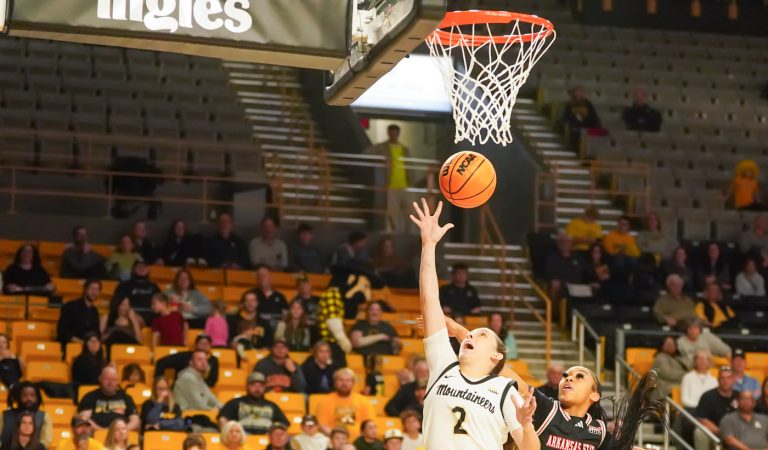
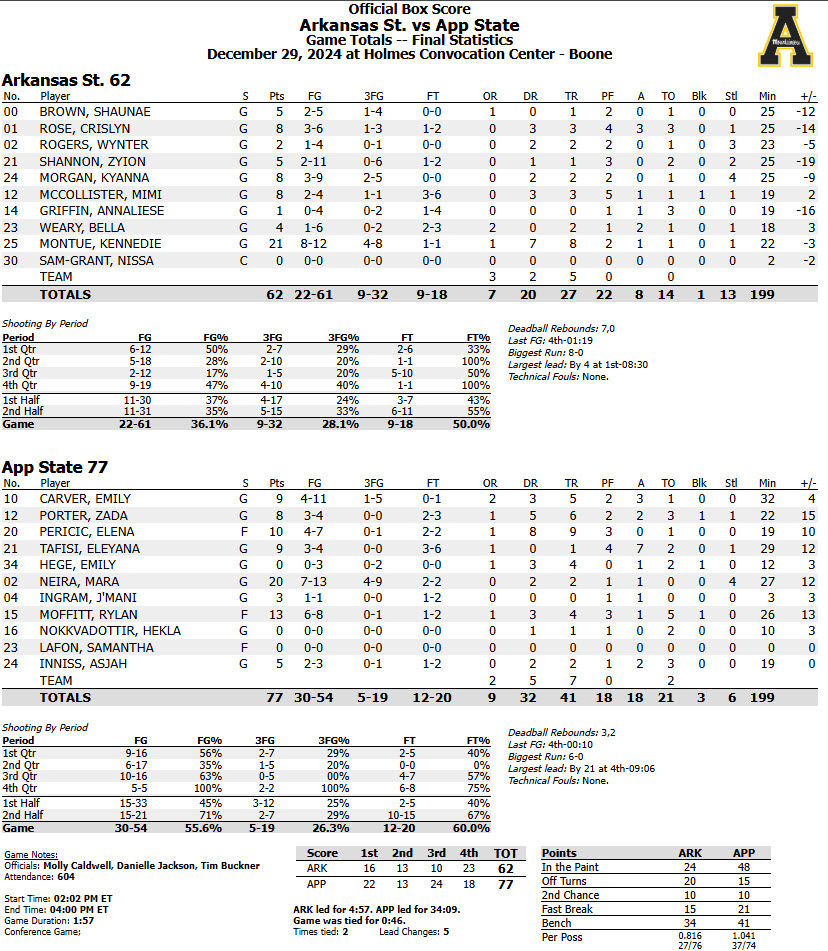
By David Rogers. BOONE, N.C. — It is almost a certainty that the App State women’s basketball team, on Dec. 29, convinced their Arkansas State counterparts that size matters. Taking advantage of a height advantage, the Mountaineers doubled up on the Red Wolves for points in the paint en route to a decisive, 77-62 win in both teams’ Sun Belt Conference season opener.
In front of paid attendance of 604 mostly App State fans and roughly 100 teddy bears, App State started slow but soon got things rolling. A 12-6 run in the final three minutes of the first quarter thrust the Mountaineers into the lead and they never relinquished it.
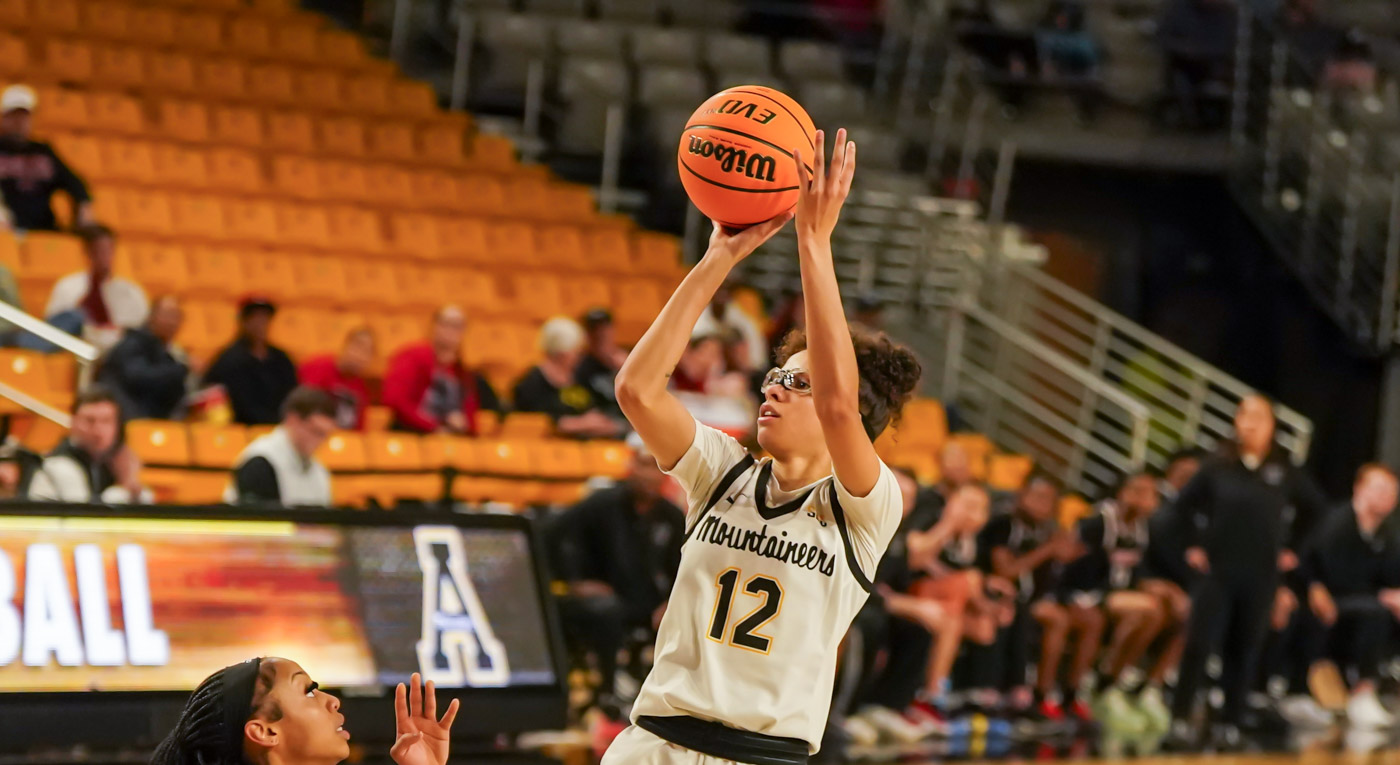
Zada Porter makes good on a second half fall away jumper for App State vs. Arkansas State on Dec. 29. Photographic image by David Rogers for High Country Sports
App State finished the opening stanza with a 22-16 lead and went to their locker room at halftime with a 35-29 advantage. They outscored Arkansas State 24-10 in the third period, which was enough to survive a 3-pointer barrage by the visitors from Jonesboro in the final quarter.
Led by the Mountaineer “bigs” Rylee Moffitt and Elena Pericic, as a team App State outscored the Red Wolves 48-24 in the paint and pulled down 41 rebounds to Arkansas State’s 27. Pericic crashed the boards for a game-high 9 rebound as well as finished the game in double figures scoring, with 10. Moffitt was also in double figures, scoring 9 of her 13 points on the night in the second half while adding 4 rebounds, a block and an assist in coming off the bench.
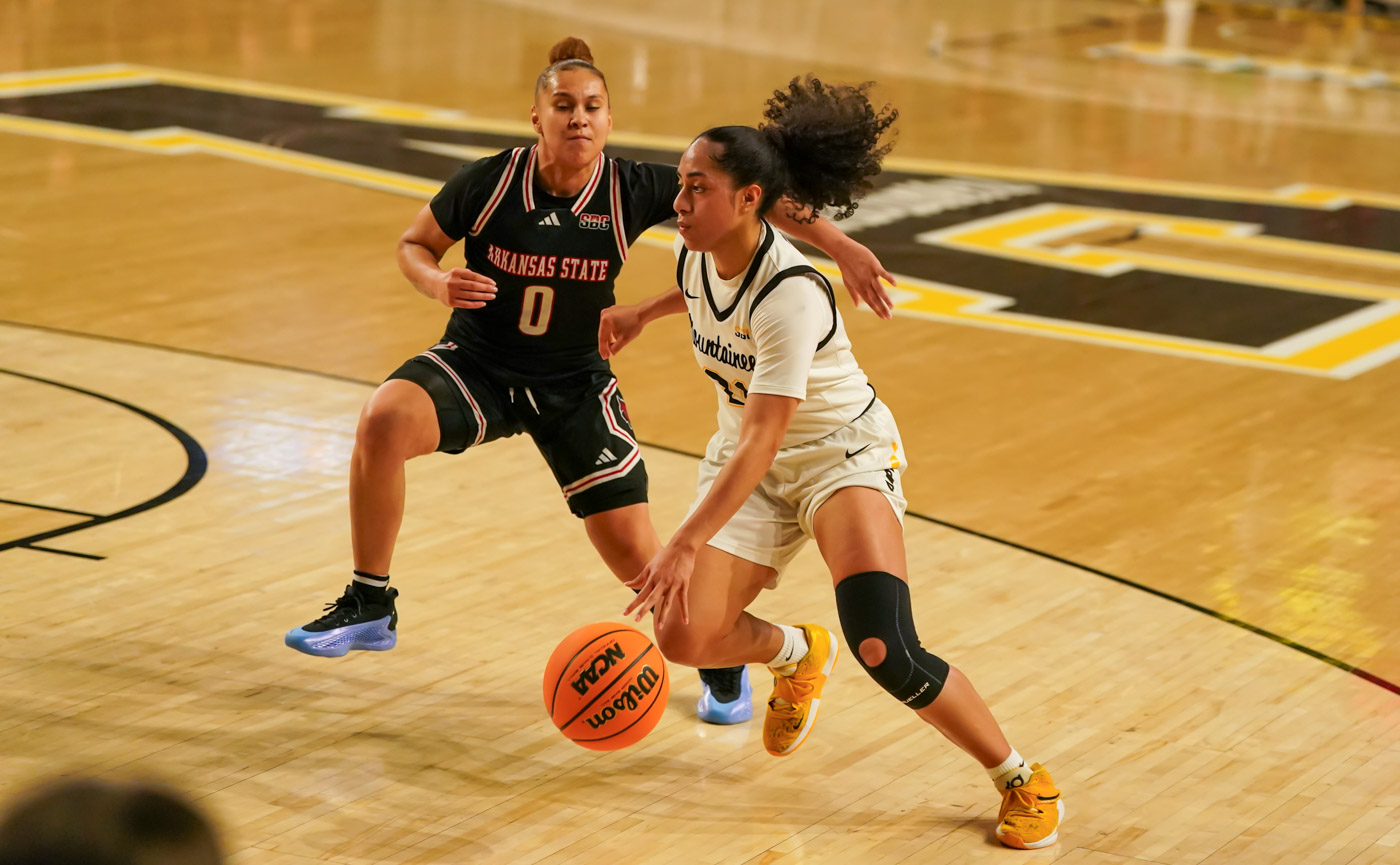
Eleyana Tafisi looks to drive the lane vs. Arkansas State on Dec. 29, in the 77-62 App State win. Photographic image by David Rogers for High Country Sports
In addition to the strong inside play, App State proved effective in transition, with 21 fastbreak points. Led by Moffitt, the Mountaineers exhibited greater roster depth, their bench outscoring the Red Wolves’ reserves, 41-34.
On 4-of-9 shooting from behind the arc, guard Mara Neira recorded a team-high 20 points. She also led App State’s disruptive defensive effort, with 4 steals on the night, tying for game-high honors in that department with Arkansas State’s Kyanna Morgan.
The Red Wolves’ starting guard, Kennedi Montue mustered a game-high 21 points but was the visitors’ only player in double figures.
Next up for the Mountaineers is a road trip to the Deep South, facing South Alabama in Mobile, Ala. on Jan. 2 and Southern Mississippi in Hattiesburg, Miss. on Jan. 4. Both are scheduled for 3 p.m. Eastern Time tipoffs.
By David Rogers. BLOWING ROCK, N.C. — For a lot of people, golf is an adventure sport. Played in the great outdoors, traversing over hill and dale with occasional side trips into the woods, sand traps, creeks or lakes, there is a certain masochistic fun in accepting the challenge of striking a tiny, 1.68 inches in diameter orb with a stick, aiming to make it go into a 4.25-inch hole some 400 to 600 yards away.
The folks who are the original orchestrators of this fun? The golf course architect, of which on a global scale there are only about 300 of them.
High Country-based Ron Cutlip is one of the newest members of an exclusive club: the American Society of Golf Course Architects (ASGCA). He was inducted last month at the annual meeting in San Francisco. Tracking Cutlip’s career and his path to ASGCA membership provides interesting insights into the creative professionals who enable these on-course adventures.
It’s not as simple as bulldozing a flat spot and cutting down a few trees.
Joining “The Club”
According to the ASGCA’s Director of Outreach, Jeff Brauer, who served as the association’s president in the 1995-96 fiscal year, gaining induction into the organization is not as simple as writing a check.
“You have to be an accomplished golf course architect. We go through an extensive vetting process,” said Brauer. “That process includes a review of a candidate’s work, citations by owners he or she might have worked for, then you have to be sponsored by at least three current ASGCA members. And that is all before the ASGCA Board of Governors votes you in.”
Members of the American Society of Golf Course Architects met in San Francisco this fall, including the induction of new members like the High Country’s Ron Cutlip. Photo submitted
Brauer added that the minimum requirement for a new member’s body of work is to have designed at least 100 holes of new courses or in one or more renovations. He pointed out that the earlier requirement was to have designed at least five 18-hole courses, but in recent years the marketplace has changed.
“Especially in the last five years and since COVID-19, there has been significant growth in playing golf as people have wanted to be outdoors rather than in confined spaces,” said Brauer. “That led to not only a lot of new 18-hole courses, but a great many course renovations. There have also been many new 9-hole and 12-hole courses. So, moving to a 100-hole requirement just made sense with the new market dynamics.”
He added that the trend toward courses with fewer holes can perhaps be explained by modern-day shorter attention spans as well as the cost of acquiring property and rising construction costs.
Who are these guys?
Golf course architects take great delight in making our outdoor adventures memorable. The rules of the game may be the same on every course, but every 18-hole, 12-hole, or 9-hole journey is created on a different artistic “canvas”: a plot of land with its own unique terrain features. Whether designing a links course near the coast or an up-and-down masterpiece in the mountains, these Michelangelos of sporting adventure use inter-disciplinary skills to give us extra-sensory experiences.
It is not as simple as bulldozing a flat spot and cutting down a few trees. Understanding the game’s various elements is important, of course, but in golf course design other academic disciplines come into play ranging from civil engineering, agronomy, landscape architecture, environmental sciences, turf management, hydrology, physics, geometry, soil sciences, botany, and even psychology to name a few.
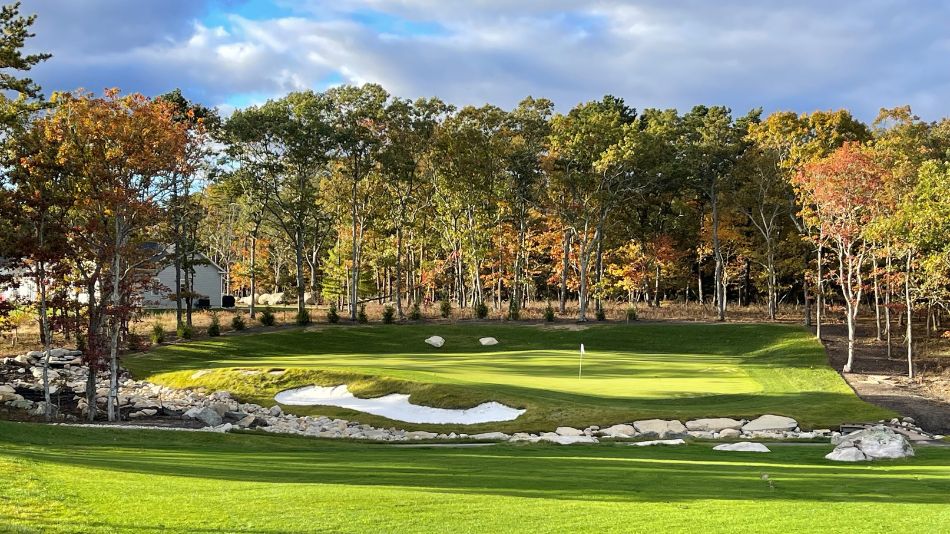
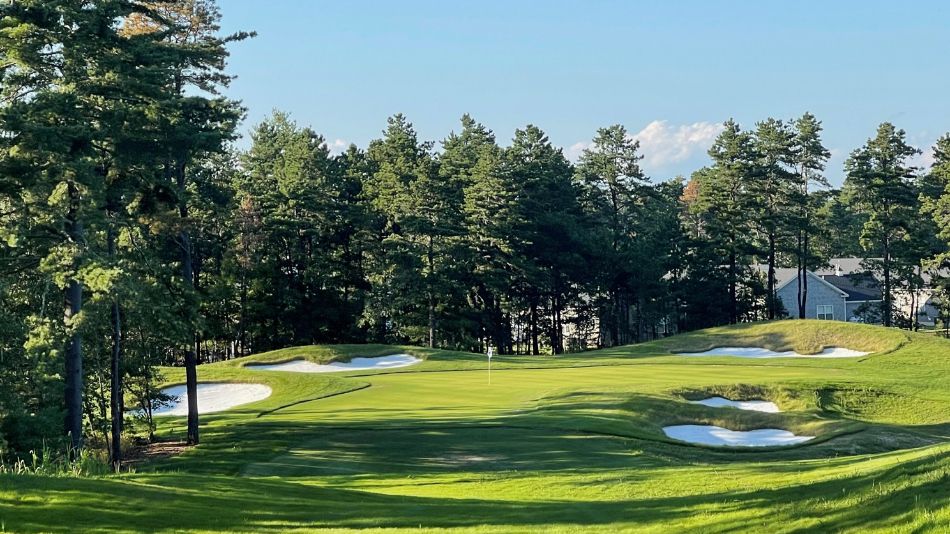
South Shore Village Golf Club’s ninth hole, in South Kingstown, Rhode Island. Photo submitted
Then, of course, there is the business side of things: evaluating market demand, site selection, estimating costs, developing a budget, securing the necessary permits, understanding construction methodologies, master planning, and considering how long it will take for the course to “grow in” sufficiently to enable playing.
Understanding the challenges and opportunities of a site’s topography, the region’s climate, the soil composition, and what makes up the site’s natural vegetation helps the designer create a course that harmonizes with its surroundings and offer a unique playing experience.
When all is said and done, it is no wonder that golf course architecture has developed as a professional trade. According to Leading Courses (www.leadingcourses.com), there are 16,572 golf courses in the United States, which amounts to 43 percent of the world’s total number.
A good golf course creates an escape from a person’s normal day.
As one of the world’s premier trade associations for golf course architecture, membership in the ASGCA is by invitation only. According to Brauer, there are fewer than 200 current members in the American society, with other smaller organizations in Europe and Australia.
Cutlip’s latest completed course design is the South Shore Golf Club, a 9-hole course in South Kingstown, R.I., an integral part of the South Shore Village planned community. The course opened last spring to rave reviews and a growing reputation for excellence among serious players. It also now serves as one of the most frequented practice facilities for the University of Rhode Island men’s golf team.
In April 2024, Ron Cutlip greets the University of Rhode Island men’s golf team. Photographic image by David Rogers for Blowing Rock News
A Donald Ross Connection
Rhode Island and golf have a special connection: legendary golf course architect Donald Ross, who ran a substantial portion of his practice from offices in Little Compton, R.I., his summertime home. Ross is regarded as the patron saint of American golf course architecture, having designed or redesigned 399 golf courses between 1900 and 1948, according to the Rhode Island Golf Association (RIGA). He was a charter member of the ASGCA. Of Ross, legendary PGA professional and golf course architect Jack Nicklaus is credited by RIGA as saying, “He seems to be the standard by which we are all measured today.”
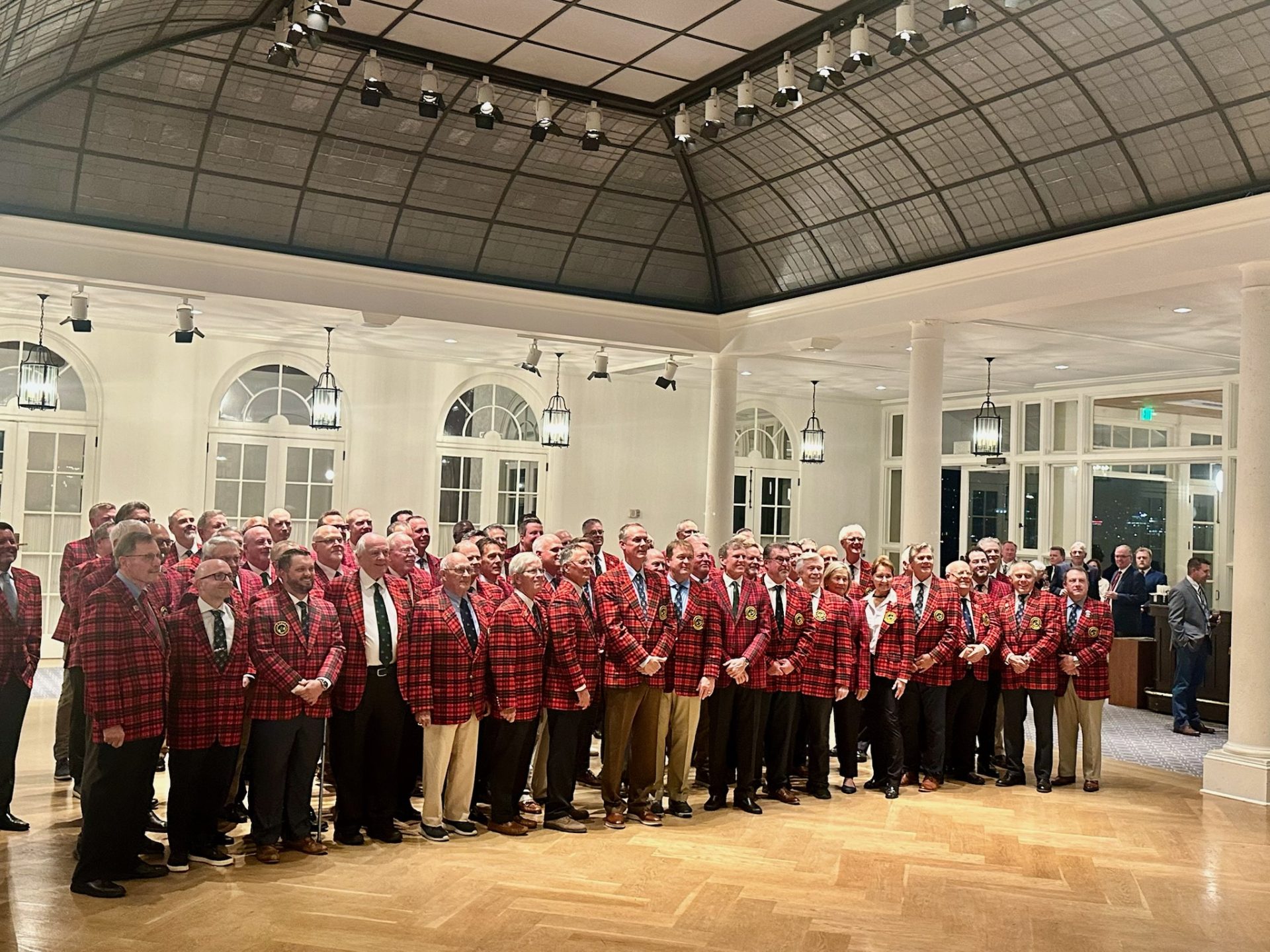
For the ASGCA, those are not idle words since the organization’s trademark, red plaid jacket (worn by all members), known as the Ross tartan, was adopted in 1973 as a tribute to the group’s honorary first president, Donald Ross, a native of Dornoch, Scotland (Scottish clans are identified by their distinctive tartan patterns, to which anyone who has attended the Highland Games on Grandfather Mountain can attest!).
Cutlip is among the golf course designers following in the Ross tradition of courses with a “natural” feel to them, taking advantage of the natural lay of the land with little in the way of intense earth moving. For Cutlip, the mental aspect of why we play golf is as important as the physical experience.
“A good golf course design creates an escape from a person’s normal day,” Cutlip told High Country Sports, recently. “In my view, the player is presented with the game of golf as well as with the dramatic beauty of nature. Potentially, even a course’s historic setting comes into play during a round.
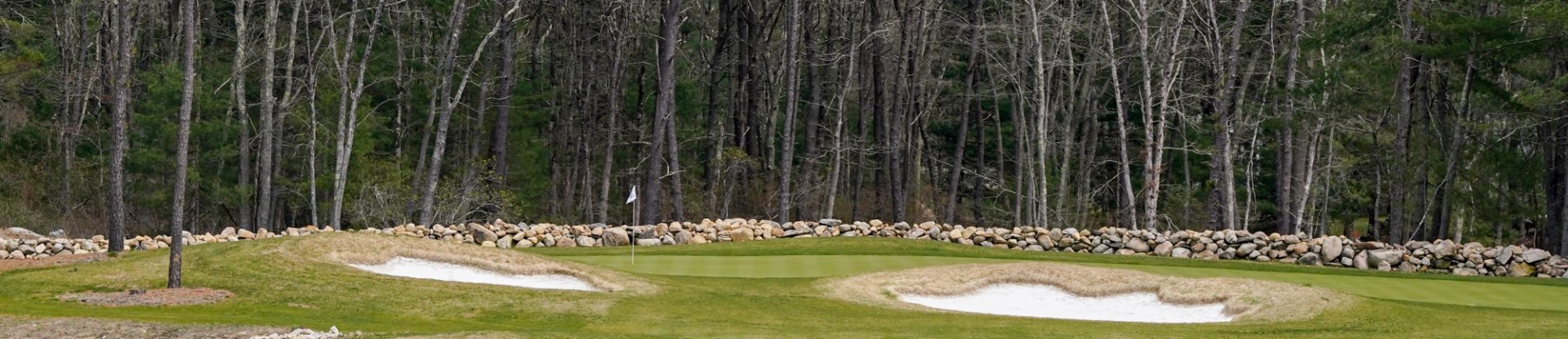
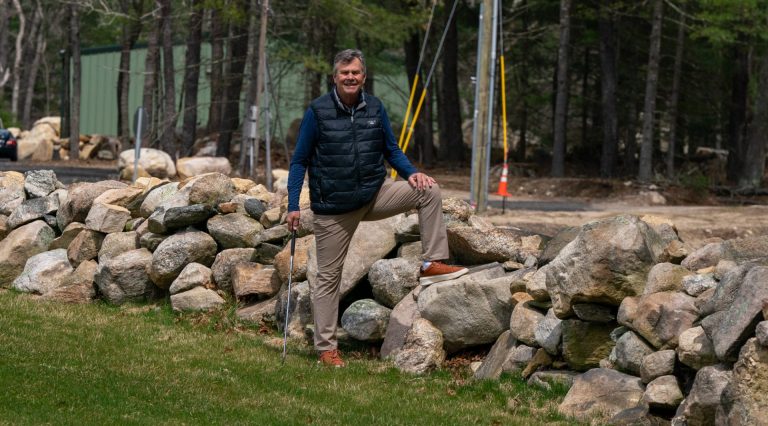
“For example, up at South Shore in Rhode Island, we developed a course that was on a farm with stone walls dating back to the 1600s. For me, it was important that we preserve those walls and integrate them into the course layout,” said Cutlip. “That’s appreciating history and it helps make a course special. We want the player to feel good about their experience and return to play again and again, whether they are a professional player or a weekend warrior.”
This stone wall from the 1600s was integrated into the layout and design of South Shore Village Golf Club by course architect Ron Cutlip. Photographic image by David Rogers for Blowing Rock News
What’s It All About?
Talking with the three current members of the ASGCA who sponsored Cutlip for membership provided us with not only insights about Cutlip, as well as about the golf course architect’s role in one of America’s favorite pastimes.
“I’ve spent a lot of time with Ron, including site visits to projects and potential projects,” said Rick Robbins in a phone interview. “I feel he has the background and personality to make a good member of ASGCA.”
There are a lot of people involved in the creation of a new golf course.
Robbins has High Country connections as the son of Spencer Robbins, one of the region’s iconic figures in tourism and development. Along with brothers Grover, Jr. and Harry Robbins, Spencer had a hand in the creation of Tweetsie Railroad, the Land of Oz, Hound Ears Golf Club and the Elk River Club, among other developments.
South Shore Village Golf Club, South Kingstown, Rhode Island. Photo submitted
Rick Robbins is a past president of the ASGCA, serving in that capacity in 2013-14. He is credited with designing or redesigning 125 courses around the world since 1991, under the banner of his firm, Robbins & Associates International. His U.S. portfolio includes courses in a variety of states, including North Carolina, Georgia, Florida, Iowa, Wisconsin, Texas and Michigan, among others.
When asked if he had any favorite projects, Robbins hesitated because all of his projects have been special to him in one way or another.
“Horseshoe Bay in Dore County, Wisconsin is one of the prettiest, nicest courses I have ever done,” he said before adding, “I’ve done four, full 18-hole designs in North Carolina, plus several renovations. A favorite is Mill Creek, in Mebane, N.C. It is on a beautiful piece of land with a lot of rolling hills, creeks and streams and wetlands.”
What gets his juices flowing in golf course design?
“Really, it is the balance between field work and the joy of sitting at a table and drawing plans. I enjoy going out in the field and working with shapers on a tractor. Golf course design is very interdisciplinary. We are working with planners, engineers, agronomists, owners… There are a lot of people involved in the construction and design of a new golf course.”
In approaching a new project, Robbins said, “I think about different ways you can play a hole under different conditions. Is the wind behind you or in your face? Can I carry this particular hazard or should I lay up short of it? You really want to give the golfer choices. It is fun to see their reactions to the decisions that have to be made and what goes into their thinking. I love going into the 19th hole and listening to the good stuff of a golfer’s day.”
All in the Family
John Harvey was also a Cutlip sponsor. He started his golf industry career in 1988, when he joined the design office of two well-known golf course architects, Robert Trent Jones, Sr. and Roger Rulewich, after graduating from Michigan State University with high honors in landscape architecture.
In a phone interview with High Country Sports, Harvey described highlights of his career: working on the Robert Trent Jones Trail in Alabama and international projects in Wales and Ireland. In the U.S., his work covers the design or redesign of courses in New York, New Jersey, Virginia, South Carolina, Michigan, Pennsylvania, Connecticut, Florida, Indiana, North Carolina and Texas.
“I knew of Ron for a long time before actually meeting him,” said Harvey. “I was practicing and had my offices in New Jersey, so I knew of him because he was practicing in the New York-New Jersey metropolitan area for many years. A few years ago, we formally met at the wedding of my nephew and his niece. That brought us closer together. It gave me a chance to look Ron in the eye, shake his hand and talk shop, as well as about family.”
It turns out, getting to know Cutlip resulted in encouraging the new member of Harvey’s extended family to also pursue inclusion in ASGCA.
“We have a lot in common,” said Harvey, “both in the people we know as well as work experiences. I encouraged Ron to apply for membership a little over a year ago, so I hope I was the nudge that finally got him to apply. I certainly felt he had the depth and body of work and that he would be a great candidate and a great representative of what embodies the ASGCA.”
Asked why he thought ASGCA membership was so important, Harvey replied, “For golf course architecture, it is the foremost (trade association) in the world. There are other societies, such as the European and Australian, but for someone working in the U.S., membership in the ASGCA is reaching a milestone in your career. It is peer recognition, but it is also marketable in terms of clientele work. It is a feather in your cap, professionally.”
The ASGCA Director of Outreach, Brauer, described becoming a member as being akin to being named to play in the NFL Pro Bowl.
“Attending his first meeting in San Francisco, Ron got to be in the same room as giants in the industry, guys like the late Pete Dye, Jack Nicklaus and so many others. And they treat you like equals. It is a magical experience and I am happy that guys like Ron are accepted. It is a very elite group,” said Brauer.
Ron and Cheryl Cutlip were all smiles when he was inducted into the American Society of Golf Course Architects, in San Francisco, sporting his new Ross red tartan plaid jacket. Photo submitted
As for what makes a golf course design special to him, Harvey said, “It is the journey with each course and the people involved, the contractor, the circumstances of the property… it is much more than just the property you are developing. All of my courses have been special, about 125 projects. A couple of special ones that come to mind are Grand Dunes in Myrtle Beach and Ballyowen in Hardyston, New Jersey. I worked on one of the last Robert Trent Jones, Sr. courses in New York, Anglebrook Golf Club in Stomers, N.Y., and Saratoga National in Saratoga Springs, N.Y.”
Harvey concluded the interview by saying how special it has been for him and Ron to have gotten closer in the last five years since their nephew and niece tied the knot.
“It is just so ironic that the world is so small that circles come together, in this case our families and our respective golf industry careers,” said Harvey.
Meeting the Golf Course Philosopher
Forrest Richardson, whose golf course architecture firm is based in Phoenix, Ariz., was Cutlip’s third, but by no means the least of his sponsors. Like Robbins, he is also a past president of ASGCA (2020-2021).
Visit his firm’s website (www.forrestrichardsongolf.com) and you quickly surmise that Richardson is a cerebral personality sitting behind the design and planning desk, based on some of his quotes about golf course design:
“Part of the fun (of golf) should be hitting different shots and not always slamming away in pursuit of length. Golf is a thoughtful game, and thinking should always be rewarded.”
“A golf course is a story to be unfolded. For the greatest enjoyment there should be anticipation, intrigue, the occasional chase scene and even a pinch of humor.”
“Golf is supposed to be fun. When you figure out the puzzle, you should score well — and scoring success is something I have always embraced in my work.
Like Harvey and Robbins, Richardson suggested that Cutlip was long overdue for membership in ASGCA.
“I have known Ron for 25 years or more. The golf course design industry is a fairly small world. We are fierce competitors, but we are always best of friends. It is a mantra we all live by. In my opinion, it was long overdue that Ron become a member of the ASGCA.”
I love going to the 19th hole and listening to the good stuff of a golfer’s day.
Waxing philosophical, Richardson explained to High Country Sports that what you give back to the industry is as important — and maybe even more so — than what you gain through ASGCA membership.
“Golf course architecture is a rare art form. Perhaps more than with any other art form, it is very important for people in our profession to share ideas,” said Richardson. “There are only about 300 of us worldwide. Over the years, I think we have proven that the sense of community works to the benefit of all. You are learning, but you are also sharing your wisdom. The main focus is not getting work but being part of a group of like-minded people, all involved in one of the most unusual art forms on earth. To appreciate our art, you either have to be playing the game or in an airplane looking down on a course. If you look back at some of the greatest art periods, such as the 1700s, 1800s, 1900s and even today, the art schools and art colonies of those times were important in the development of different artistic styles. I think that same concept applies to golf course design.”
South Shore Village Golf Course, South Kingstown, Rhode Island, was designed by High Country-based golf course architect Ron Cutlip. Photo submitted
Richardson primarily focuses his work in arid climate projects of the western United States. Look over a portfolio list and you find a lot of Arizona and California courses, as well as sashays into Utah, Oklahoma, Kansas, Montana, Wyoming, Texas, Nevada and Alaska, among other states. But international names crop up in the list, too, including Mexico, Sweden, India and Bulgaria.
Richardson and Cutlip both had contributions to The Hideout course, in Monticello, Utah. Richardson did the final design work. Cutlip did the original work on the project for the U.S. Department of Energy.
“The property previously was a uranium processing site, so this was a reclamation project. The Department of Energy hired me to do the original work for regrading it, which I did so it could be used as a future golf course. Later, Forrest came in and made it a golf course,” Cutlip recalled.
Cutlip’s thoughts on golf course design echoed many of the other professionals who sponsored him.
“I love going out onto a piece of land and creating something spectacular,” said Cutlip. “I want it to look like it has been there a hundred years, that the golf course fits into the flow of the land. I love working with the shapers. I have to have my plans submitted for approval by the land owners and any regulatory agencies, but the true creativity comes when you take those plans and go into the field and start making those adjustments.
The property was originally a uranium processing site, so this was a reclamation project, eventually turning it into a golf course.
“The onsite adjustments take the design to a higher level than anything you could ever achieve on a drafting table. I also love the interdisciplinary aspect, working with different types of engineers whether civil, environmental, soil, and others. I will frequently work with architects on the clubhouse facilities. As a golf course architect I am working in the planning and there are a lot of things to consider. Is it in a subdivision or a standalone course? You are working with soil, water, and earth moving.
“Ultimately, what I like to do is take what nature has given me on a property and accentuate it,” said Cutlip. “Like with those stone walls from the 1600s on the South Shore course, I really like taking something old and integrating it with my new course, making it look and feel like they have always been a part of each other.”
Some of the names in Cutlip’s portfolio include Top of the World Golf Club (Lake George, N.Y.), Azalea Sands (Myrtle Beach, S.C.), Mohican Hills (Jeromesville, Ohio), Ramsey Golf & Country Club (Ramsey, N.J.) Stonebridge Golf Links (Lexington, S.C.), Fire Ridge Golf Club (Millersburg, Ohio), Arcadian Shores (Myrtle Beach, S.C.), Pine Hills Country Club (Taylor, Pa.) and Riverdale Country Club (Riverdale, N.J.), Crytal Springs (Hopewell, Ohio) and High Mountain Golf Club (Franklin Lakes, N.J.) and Canyon Club (Armonk, N.Y.), among others.
By David Rogers. BLOWING ROCK, N.C. — For a lot of people, golf is an adventure sport. Played in the great outdoors, traversing over hill and dale with occasional side trips into the woods, sand traps, creeks or lakes, there is a certain masochistic fun in accepting the challenge of striking a tiny, 1.68 inches in diameter orb with a stick, aiming to make it go into a 4.25-inch hole some 400 to 600 yards away.
The folks who are the original orchestrators of this fun? The golf course architect, of which on a global scale there are only about 300 of them.
It is not as simple as bulldozing a flat spot and cutting down a few trees.
High Country-based Ron Cutlip is one of the newest members of an exclusive club: the American Society of Golf Course Architects (ASGCA). He was inducted last month at the annual meeting in San Francisco. Tracking Cutlip’s career and his path to ASGCA membership provides interesting insights into the creative professionals who enable these on-course adventures.
American Society of Golf Course Architects gather in San Francisco for their annual meeting, with the High Country’s Ron Cutlip as one of the orgranization’s newest members inducted in 2024. Photo courtesy of ASGCA.
According to the ASGCA’s Director of Outreach, Jeff Brauer, who served as the association’s president in the 1995-96 fiscal year, gaining induction into the organization is not as simple as writing a check.
“You have to be an accomplished golf course architect. We go through an extensive vetting process,” said Brauer. “That process includes a review of a candidate’s work, citations by owners he or she might have worked for, then you have to be sponsored by at least three current ASGCA members. And that is all before the ASGCA Board of Governors votes you in.”
Brauer added that the minimum requirement for a new member’s body of work is to have designed at least 100 holes of new courses or in one or more renovations. He pointed out that the earlier requirement was to have designed at least five 18-hole courses, but in recent years the marketplace has changed.
Ron Cutlip and wife Cheryl take a moment in San Francisco where Cutlip was sporting his new Ross tartan plaid jacket as one of ASGCA’s newest inductees. Photo courtesy of ASGCA
“Especially in the last five years and since COVID-19, there has been significant growth in playing golf as people have wanted to be outdoors rather than in confined spaces,” said Brauer. “That led to not only a lot of new 18-hole courses, but a great many course renovations. There have also been many new 9-hole and 12-hole courses. So, moving to a 100-hole requirement just made sense with the new market dynamics.”
He added that the trend toward courses with fewer holes can perhaps be explained by modern-day shorter attention spans as well as the cost of acquiring property and rising construction costs.
Who are these guys?
Golf course architects take great delight in making our outdoor adventures memorable. The rules of the game may be the same on every course, but every 18-hole, 12-hole, or 9-hole journey is created on a different artistic “canvas”: a plot of land with its own unique terrain features. Whether designing a links course near the coast or an up-and-down masterpiece in the mountains, these Michelangelos of sporting adventure use inter-disciplinary skills to give us extra-sensory experiences.
It is not as simple as bulldozing a flat spot and cutting down a few trees. Understanding the game’s various elements is important, of course, but in golf course design other academic disciplines come into play ranging from civil engineering, agronomy, landscape architecture, environmental sciences, turf management, hydrology, physics, geometry, soil sciences, botany, and even psychology to name a few.
Then, of course, there is the business side of things: evaluating market demand, site selection, estimating costs, developing a budget, securing the necessary permits, understanding construction methodologies, master planning, and considering how long it will take for the course to “grow in” sufficiently to enable playing.
The South Shore Golf Club course’s signature hole is No. 9, the course designed by High Country golf course architect Ron Cutlip. Photo submitted
Understanding the challenges and opportunities of a site’s topography, the region’s climate, the soil composition, and what makes up the site’s natural vegetation helps the designer create a course that harmonizes with its surroundings and offer a unique playing experience.
When all is said and done, it is no wonder that golf course architecture has developed as a professional trade. According to Leading Courses (www.leadingcourses.com), there are 16,572 golf courses in the United States, which amounts to 43 percent of the world’s total number.
A good golf course creates an escape from a person’s normal day.
As one of the world’s premier trade associations for golf course architecture, membership in the ASGCA is by invitation only. According to Brauer, there are fewer than 200 current members in the American society, with other smaller organizations in Europe and Australia.
Cutlip’s latest completed course design is the South Shore Golf Club, a 9-hole course in South Kingstown, R.I., an integral part of the South Shore Village planned community. The course opened last spring to rave reviews and a growing reputation for excellence among serious players. It also now serves as one of the most frequented practice facilities for the University of Rhode Island men’s golf team.
Ron Cutlip, left, greets members of the University of Rhode Island men’s golf team at South Shore Golf Club. Photographic image by David Rogers for High Country Sports
A Donald Ross Connection
Rhode Island and golf have a special connection: legendary golf course architect Donald Ross, who ran a substantial portion of his practice from offices in Little Compton, R.I., his summertime home. Ross is regarded as the patron saint of American golf course architecture, having designed or redesigned 399 golf courses between 1900 and 1948, according to the Rhode Island Golf Association (RIGA). He was a charter member of the ASGCA. Of Ross, legendary PGA professional and golf course architect Jack Nicklaus is credited by RIGA as saying, “He seems to be the standard by which we are all measured today.”
For the ASGCA, those are not idle words since the organization’s trademark, red plaid jacket (worn by all members), known as the Ross tartan, was adopted in 1973 as a tribute to the group’s honorary first president, Donald Ross, a native of Dornoch, Scotland (Scottish clans are identified by their distinctive tartan patterns, to which anyone who has attended the Highland Games on Grandfather Mountain can attest!).
Ron Cutlip playing on the South Shore Golf Club he designed. Photographic image by David Rogers for High Country Sports
Cutlip is among the golf course designers following in the Ross tradition of courses with a “natural” feel to them, taking advantage of the natural lay of the land with little in the way of intense earth moving. For Cutlip, the mental aspect of why we play golf is as important as the physical experience.
“A good golf course design creates an escape from a person’s normal day,” Cutlip told High Country Sports, recently. “In my view, the player is presented with the game of golf as well as with the dramatic beauty of nature. Potentially, even a course’s historic setting comes into play during a round.
“For example, up at South Shore in Rhode Island, we developed a course that was on a farm with stone walls dating back to the 1600s. For me, it was important that we preserve those walls and integrate them into the course layout,” said Cutlip. “That’s appreciating history and it helps make a course special. We want the player to feel good about their experience and return to play again and again, whether they are a professional player or a weekend warrior.”
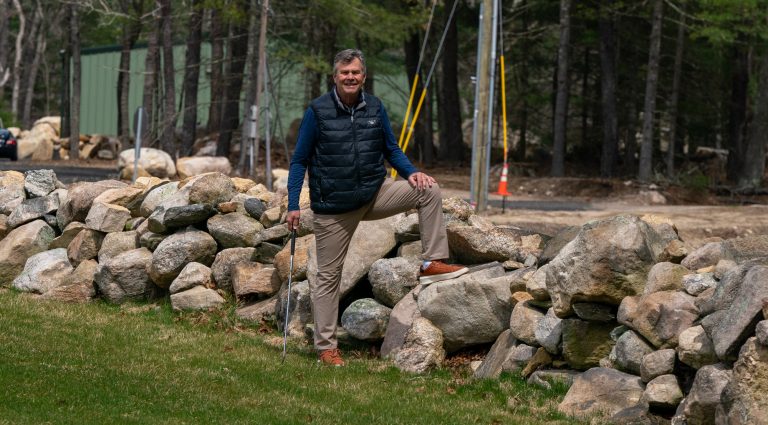
Cutlip integrated stone walls dating back to the 1600s into the golf course design at South Shore Golf Club in South Kingstown, R.I. Photographic image by David Rogers for High Country Sports
What’s It All About?
Talking with the three current members of the ASGCA who sponsored Cutlip for membership provided us with not only insights about Cutlip, as well as about the golf course architect’s role in one of America’s favorite pastimes.
“I’ve spent a lot of time with Ron, including site visits to projects and potential projects,” said Rick Robbins in a phone interview. “I feel he has the background and personality to make a good member of ASGCA.”
There are a lot of people involved in the design and construction of a new golf course.
Robbins has High Country connections as the son of Spencer Robbins, one of the region’s iconic figures in tourism and development. Along with brothers Grover, Jr. and Harry Robbins, Spencer had a hand in the creation of Tweetsie Railroad, the Land of Oz, Hound Ears Golf Club and the Elk River Club, among other developments.
Rick Robbins is a past president of the ASGCA, serving in that capacity in 2013-14. He is credited with designing or redesigning 125 courses around the world since 1991, under the banner of his firm, Robbins & Associates International. His U.S. portfolio includes courses in a variety of states, including North Carolina, Georgia, Florida, Iowa, Wisconsin, Texas and Michigan, among others.
When asked if he had any favorite projects, Robbins hesitated because all of his projects have been special to him in one way or another.
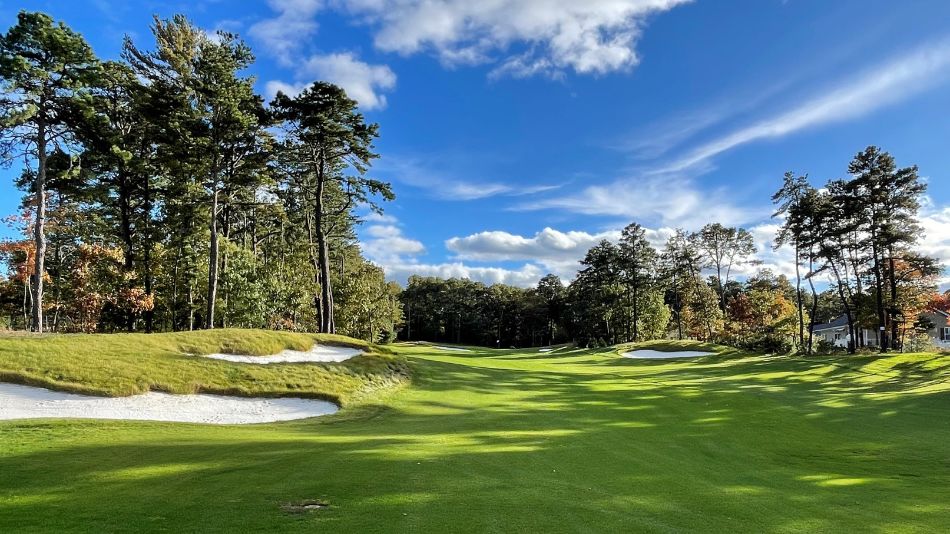
South Shore Village Golf Club, South Kingston, R.I. Photo submitted
“Horseshoe Bay in Dore County, Wisconsin is one of the prettiest, nicest courses I have ever done,” he said before adding, “I’ve done four, full 18-hole designs in North Carolina, plus several renovations. A favorite is Mill Creek, in Mebane, N.C. It is on a beautiful piece of land with a lot of rolling hills, creeks and streams and wetlands.”
I love going into the 19th hole and listening to the good stuff of a golfer’s day.
What gets his juices flowing in golf course design?
“Really, it is the balance between field work and the joy of sitting at a table and drawing plans. I enjoy going out in the field and working with shapers on a tractor. Golf course design is very interdisciplinary. We are working with planners, engineers, agronomists, owners… There are a lot of people involved in the construction and design of a new golf course.”
In approaching a new project, Robbins said, “I think about different ways you can play a hole under different conditions. Is the wind behind you or in your face? Can I carry this particular hazard or should I lay up short of it? You really want to give the golfer choices. It is fun to see their reactions to the decisions that have to be made and what goes into their thinking. I love going into the 19th hole and listening to the good stuff of a golfer’s day.”
All in the Family
John Harvey was also a Cutlip sponsor. He started his golf industry career in 1988, when he joined the design office of two well-known golf course architects, Robert Trent Jones, Sr. and Roger Rulewich, after graduating from Michigan State University with high honors in landscape architecture.
In a phone interview with High Country Sports, Harvey described highlights of his career: working on the Robert Trent Jones Trail in Alabama and international projects in Wales and Ireland. In the U.S., his work covers the design or redesign of courses in New York, New Jersey, Virginia, South Carolina, Michigan, Pennsylvania, Connecticut, Florida, Indiana, North Carolina and Texas.
“I knew of Ron for a long time before actually meeting him,” said Harvey. “I was practicing and had my offices in New Jersey, so I knew of him because he was practicing in the New York-New Jersey metropolitan area for many years. A few years ago, we formally met at the wedding of my nephew and his niece. That brought us closer together. It gave me a chance to look Ron in the eye, shake his hand and talk shop, as well as about family.”
South Shore Village Golf Club in South Kingstown, R.I. Photo submitted
It turns out, getting to know Cutlip resulted in encouraging the new member of Harvey’s extended family to also pursue inclusion in ASGCA.
“We have a lot in common,” said Harvey, “both in the people we know as well as work experiences. I encouraged Ron to apply for membership a little over a year ago, so I hope I was the nudge that finally got him to apply. I certainly felt he had the depth and body of work and that he would be a great candidate and a great representative of what embodies the ASGCA.”
Asked why he thought ASGCA membership was so important, Harvey replied, “For golf course architecture, it is the foremost (trade association) in the world. There are other societies, such as the European and Australian, but for someone working in the U.S., membership in the ASGCA is reaching a milestone in your career. It is peer recognition, but it is also marketable in terms of clientele work. It is a feather in your cap, professionally.”
The ASGCA Director of Outreach, Brauer, described becoming a member as being akin to being named to play in the NFL Pro Bowl.
“Attending his first meeting in San Francisco, Ron got to be in the same room as giants in the industry, guys like the late Pete Dye, Jack Nicklaus and so many others. And they treat you like equals. It is a magical experience and I am happy that guys like Ron are accepted. It is a very elite group,” said Brauer.
As for what makes a golf course design special to him, Harvey said, “It is the journey with each course and the people involved, the contractor, the circumstances of the property… it is much more than just the property you are developing. All of my courses have been special, about 125 projects. A couple of special ones that come to mind are Grand Dunes in Myrtle Beach and Ballyowen in Hardyston, New Jersey. I worked on one of the last Robert Trent Jones, Sr. courses in New York, Anglebrook Golf Club in Stomers, N.Y., and Saratoga National in Saratoga Springs, N.Y.”
Harvey concluded the interview by saying how special it has been for him and Ron to have gotten closer in the last five years since their nephew and niece tied the knot.
“It is just so ironic that the world is so small that circles come together, in this case our families and our respective golf industry careers,” said Harvey.
Meeting the Golf Course Philosopher
Forrest Richardson, whose golf course architecture firm is based in Phoenix, Ariz., was Cutlip’s third, but by no means the least of his sponsors. Like Robbins, he is also a past president of ASGCA (2020-2021).
I love going onto a piece of land and creating something spectacular.
Visit his firm’s website (www.forrestrichardsongolf.com) and you quickly surmise that Richardson is a cerebral personality sitting behind the design and planning desk, based on some of his quotes about golf course design:
“Part of the fun (of golf) should be hitting different shots and not always slamming away in pursuit of length. Golf is a thoughtful game, and thinking should always be rewarded.”
“A golf course is a story to be unfolded. For the greatest enjoyment there should be anticipation, intrigue, the occasional chase scene and even a pinch of humor.”
“Golf is supposed to be fun. When you figure out the puzzle, you should score well — and scoring success is something I have always embraced in my work.
Like Harvey and Robbins, Richardson suggested that Cutlip was long overdue for membership in ASGCA.
“I have known Ron for 25 years or more. The golf course design industry is a fairly small world. We are fierce competitors, but we are always best of friends. It is a mantra we all live by. In my opinion, it was long overdue that Ron become a member of the ASGCA.”
Waxing philosophical, Richardson explained to High Country Sports that what you give back to the industry is as important — and maybe even more so — than what you gain through ASGCA membership.
Like the green jacket is trademark apparel for The Masters Tournament, the American Society of Golf Course Architects as the Ross tartan plaid jacket. That’s the High Country’s Ron Cutlip in the center of the first row. Photo submitted.
“Golf course architecture is a rare art form. Perhaps more than with any other art form, it is very important for people in our profession to share ideas,” said Richardson. “There are only about 300 of us worldwide. Over the years, I think we have proven that the sense of community works to the benefit of all. You are learning, but you are also sharing your wisdom. The main focus is not getting work but being part of a group of like-minded people, all involved in one of the most unusual art forms on earth. To appreciate our art, you either have to be playing the game or in an airplane looking down on a course. If you look back at some of the greatest art periods, such as the 1700s, 1800s, 1900s and even today, the art schools and art colonies of those times were important in the development of different artistic styles. I think that same concept applies to golf course design.”
Richardson primarily focuses his work in arid climate projects of the western United States. Look over a portfolio list and you find a lot of Arizona and California courses, as well as sashays into Utah, Oklahoma, Kansas, Montana, Wyoming, Texas, Nevada and Alaska, among other states. But international names crop up in the list, too, including Mexico, Sweden, India and Bulgaria.
Richardson and Cutlip both had contributions to The Hideout course, in Monticello, Utah. Richardson did the final design work. Cutlip did the original work on the project for the U.S. Department of Energy.
“The property previously was a uranium processing site, so this was a reclamation project. The Department of Energy hired me to do the original work for regrading it, which I did so it could be used as a future golf course. Later, Forrest came in and made it a golf course,” Cutlip recalled.
Cutlip’s thoughts on golf course design echoed many of the other professionals who sponsored him.
“I love going out onto a piece of land and creating something spectacular,” said Cutlip. “I want it to look like it has been there a hundred years, that the golf course fits into the flow of the land. I love working with the shapers. I have to have my plans submitted for approval by the land owners and any regulatory agencies, but the true creativity comes when you take those plans and go into the field and start making those adjustments.
South Shore Golf Club, designed by Ron Cutlip, in South Kingstown, Rhode Island. Photo submitted
“The onsite adjustments take the design to a higher level than anything you could ever achieve on a drafting table. I also love the interdisciplinary aspect, working with different types of engineers whether civil, environmental, soil, and others. I will frequently work with architects on the clubhouse facilities. As a golf course architect I am working in the planning and there are a lot of things to consider. Is it in a subdivision or a standalone course? You are working with soil, water, and earth moving.
“Ultimately, what I like to do is take what nature has given me on a property and accentuate it,” said Cutlip. “Like with those stone walls from the 1600s on the South Shore course, I really like taking something old and integrating it with my new course, making it look and feel like they have always been a part of each other.”
Some of the names in Cutlip’s portfolio include Top of the World Golf Club (Lake George, N.Y.), Azalea Sands (Myrtle Beach, S.C.), Mohican Hills (Jeromesville, Ohio), Ramsey Golf & Country Club (Ramsey, N.J.) Stonebridge Golf Links (Lexington, S.C.), Fire Ridge Golf Club (Millersburg, Ohio), Arcadian Shores (Myrtle Beach, S.C.), Pine Hills Country Club (Taylor, Pa.) and Riverdale Country Club (Riverdale, N.J.), Crytal Springs (Hopewell, Ohio) and High Mountain Golf Club (Franklin Lakes, N.J.) and Canyon Club (Armonk, N.Y.), among others.
Raymond Lloyd Buckner, age 85 of Blowing Rock, passed away Saturday, December 15, 2024.
He was the son of the late Lloyd and Ella Frizsell Buckner.
He served in the United States Marine Corp and retired after many years in the maintenance department at the Blowing Rock Hospital.
In addition to his parents, he was preceded in death by his wife Cleta Coffey Buckner, a son, Jason Buckner, a daughter-in-law Nichole Buckner, brothers Earl and Benny Buckner, sisters, Grace, Neal, Esther and Ruth.
He is survived by a daughter, Kimberly Greene and husband Mark of Blowing Rock, 2 sons, Lloyd J. Buckner and wife Patricia of Blowing Rock, and Doug Buckner and wife Betty of Zionville, one brother Grady Buckner of Hudson, one sister, Madeline Carver of Lenoir.
Many grandchildren and great-grandchildren also survive.
Funeral services will be conducted Saturday, December 21, 2024 at 3:00 p.m. in the Austin & Barnes Funeral Home Chapel.
The family will receive friends prior to the services from 2:00-3:00 p.m.
Online condolences may be shared with the family at the website www.austinandbarnesfuneralhome.com.
Austin & Barnes Funeral Home and Crematory is serving the Buckner family.
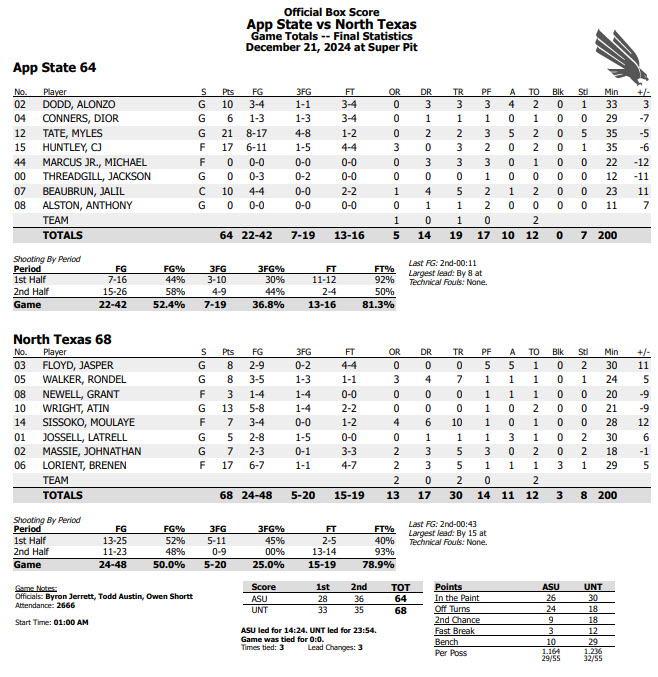
By David Rogers. DENTON, Texas — After App State fell behind North Texas by 15 points early in the second half, senior guard Myles Tate scored 19 of his game-high 21 points after intermission to bring the Mountaineers to within two points of tying the Mean Green. It wasn’t quite enough, however, with North Texas holding off their visitors from Boone, 68-64.
The Mean Green win came in spite of four Mountaineers scoring in double figures, including forward C J Huntley recording his 1,000th career points. The Huntersville, N.C. native and alum of Davidson Day School is just the 37th Mountaineer to achieve that milestone.
In addition to Tate’s 21 points and Huntley’s 17 points for the game vs. North Texas, Alonzo Dodd and Jalil Beaubrun each scored 10 points on the night.
The Mean Green led by just five points at halftime, but scored the first four points of the second half to take a 9-point advantage, 37-28, following a fast break layup and two free throws from 6-1 senior guard Atin Wright, a native of Hawthorne, Calif. who started his college career playing at Cal State Northridge for three years before transferring to Drake University a year ago, then using the transfer portal again to arrive at North Texas. He played in 32 games at Drake in 2023-24, starting in all 32 of them.
Four App State turnovers in the first seven minutes of the second half allowed North Texas to jump out to a 15-point lead, a run that included five straight made free throws by the Lone Star State players, two by Rondel Walker and three by Brenen Lorient.
But the Mountaineers clawed back into the fray, led by Tate’s four buckets from long distance in the last 11 minutes along with scoring contributions from Dodd, Huntley and Beaubrun and a tightened App State defense.
With time running out (only 19 seconds remained when Tate hit on a 3-pointer to close the deficit to 64-62), App State was forced to foul. Unfortunately, the Mean Green’s Jasper Floyd was good on 4-of-4 from the charity stripe in the last 19 seconds, effectively thwarting the Mountaineers’ comeback rally.
App State (6-6 overall, 0-1 in Sun Belt) will take some time off for the holidays, returning to the court on Thursday, Jan. 2, to take on Troy in a Sun Belt Conference home opener at the Holmes Convocation Center. Tipoff is slated for 6:30 p.m.
North Texas (8-3 overall), a member of the American Athletic Conference, stays at home to host Houston Christian on Dec. 22 and University of Alabama-Birmingham (UAB) on Dec. 31, before opening the new year at Memphis on Jan. 5 in a first AAC contest for the season.
By Bret Stelow. BOONE, N.C. — On Dec. 19, App State Football head coach Dowell Loggains announced the hiring of Riley Watkins as an offensive assistant coach.
Watkins has worked on SEC staffs at Arkansas, Missouri and South Carolina during the last four seasons. He has spent the previous two seasons as an offensive graduate assistant working with quarterbacks and wide receivers at South Carolina, where Loggains was the offensive coordinator in 2023 and 2024.
“Riley has been a huge part of our offensive success at both South Carolina and Arkansas,” Loggains said. “We’re excited for him to join our staff and to welcome him and his wife, Kaylee, to App State.”
Loggains and Watkins also worked together at Arkansas in 2021, when Watkins was an offensive/recruiting undergraduate assistant. He was an offensive quality control coach at Missouri with former App State head coach Eliah Drinkwitz in 2022.
“I’m really excited to join the App State staff with Coach Loggains. He is a great man and a great offensive mind. I have so much respect for the history and tradition of the App State program. My wife, Kaylee, and I are excited to get here. I’m ready to get to work and compete for more championships here on the mountain.”
With Loggains and Watkins on the same offensive staff at South Carolina, wide receiver and future NFL first-round pick Xavier Legette teamed with future NFL quarterback Spencer Rattler in 2023 to form one of the most lethal pass-and-catch combinations in the country. Legette was a first-team All-SEC performer and third-team All-American during a season in which he caught 71 passes for 1,255 yards and seven touchdowns.
In 2024, 15th-ranked South Carolina ended the regular season with top-50 national rankings in scoring, yardage, first downs and completion percentage. LaNorris Sellers turned into one of college football’s most dangerous dual-threat quarterbacks, with 10 players having at least one receiving touchdown.
Missouri averaged 214.1 passing yards per game in 2022, with Brady Cook throwing to the likes of Dominic Lovett (846 receiving yards) and Luther Burden (six receiving touchdowns).
Arkansas finished the 2021 season with final rankings of No. 20 in the AFCA Coaches Poll and No. 21 in the AP Top 25 thanks to a 9-4 record that included an Outback Bowl win against Penn State.
A native of Republic, Missouri, Watkins was an all-region performer at Republic High School before spending time as a quarterback, running back and tight end at Pittsburg State in Kansas. He graduated from Pittsburg State in 2022 and has a wife, Kaylee.